Why Do Governments and Companies Issue Bonds? The Hidden Engine That Keeps the World Running
Imagine Someone Asked You for $1 Billion…
If your best friend asked to borrow $100, you’d probably ask a few questions.
Now imagine someone asking for $1 billion.
Sounds crazy, right?
Yet this happens every single day—not between friends, but between governments, companies, and investors.
The solution?
Bonds.
Bonds quietly finance many of the things you use every day, from highways and airports to smartphones and renewable energy projects.
Once you understand why bonds exist, you’ll never look at investing—or the economy—the same way again.
First Things First: What Is a Bond?
A bond is simply a promise.
One party says:
“Lend me money today, and I’ll pay you interest while you wait. Then I’ll pay you everything back on an agreed date.”
That’s it.
The borrower gets the money they need.
The investor earns income.
Everyone wins—assuming the borrower keeps their promise.
Why Don’t Governments Just Print More Money?
This is one of the most common questions people ask.
If governments control the printing presses…
…why borrow money at all?
Because printing unlimited money creates a dangerous problem:
Inflation
Imagine there are only 100 pizzas in town.
Everyone suddenly has twice as much money.
Did the town magically get more pizzas?
No.
People simply compete harder for the same pizzas.
Prices rise.
Your money buys less.
Now replace pizzas with:
- Houses
- Cars
- Groceries
- Gasoline
- Healthcare
That’s inflation.
Borrowing through bonds allows governments to raise money without flooding the economy with newly created cash.
So What Do Governments Actually Spend Bond Money On?
More than most people realize.
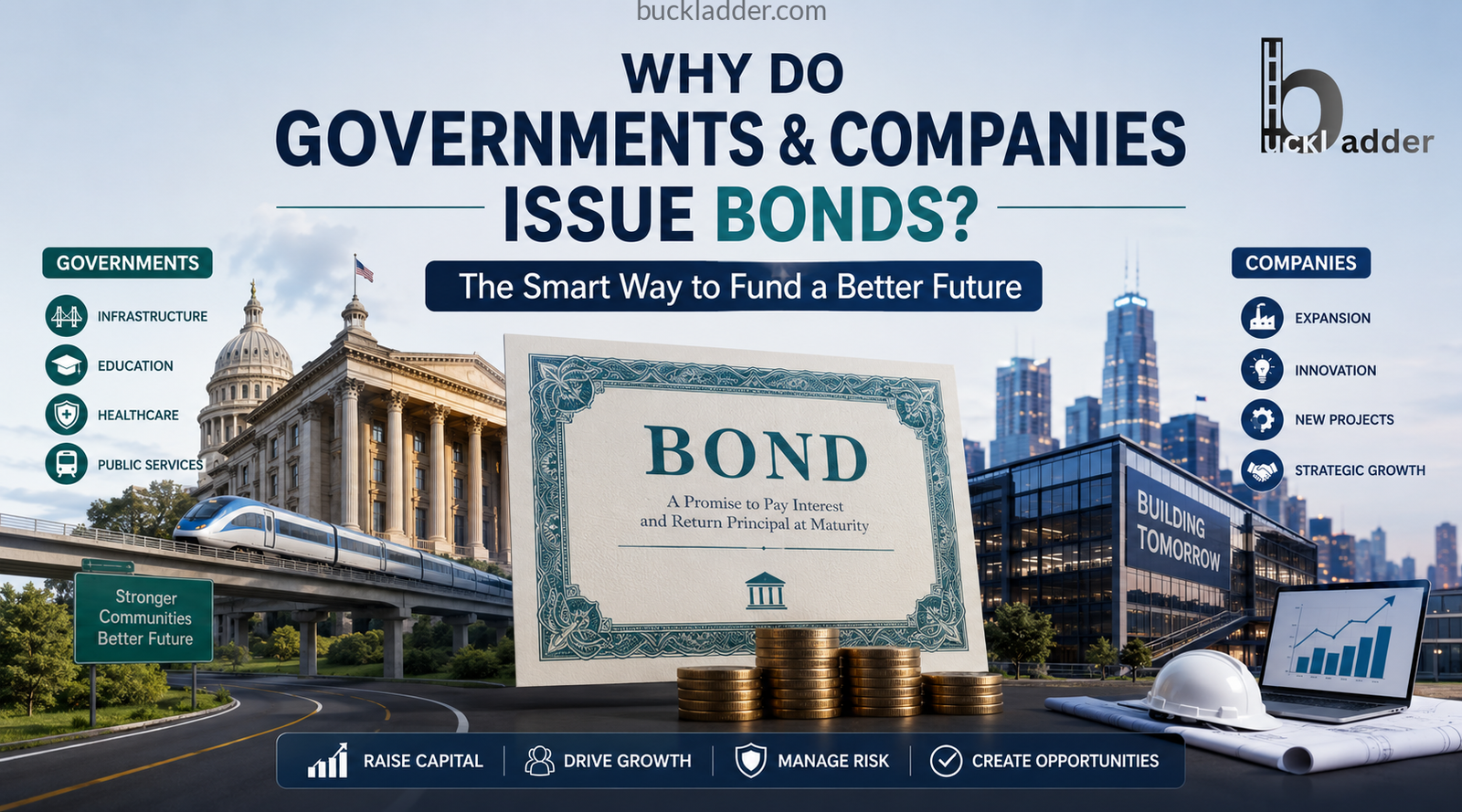
Bond money helps fund:
- Roads and bridges
- Schools and universities
- Hospitals
- Military defense
- Public transportation
- Disaster recovery
- Water systems
- Parks
- Airports
- Social programs
Every time you drive over a bridge or land at an airport, there’s a good chance bonds helped pay for it.
Why Don’t Governments Just Raise Taxes Instead?
Imagine your city suddenly needs $10 billion to rebuild after a hurricane.
Increasing taxes enough to cover the cost immediately would be painful for residents and businesses.
Instead, governments can:
✔ Borrow today
✔ Rebuild immediately
✔ Repay the debt gradually over many years
Future taxpayers who also benefit from the new infrastructure help share the cost.
Why Companies Issue Bonds Instead of Taking Bank Loans
Businesses often face the same challenge.
Suppose a company wants to build a new factory costing $5 billion.
A traditional bank loan may not be practical because:
- The amount is enormous.
- The repayment period could span decades.
- Banks may not want to shoulder all the risk.
Instead, the company can issue bonds to thousands of investors.
Rather than one lender providing billions of dollars, many investors each contribute a small piece.
A Real-World Example
Imagine a company wants to build a new electric vehicle factory.
The project costs $2 billion.
Instead of relying on a bank:
The company issues 2 million bonds worth $1,000 each.
Investors buy those bonds.
The company immediately receives the $2 billion needed to start construction.
In return, it agrees to:
- Pay investors regular interest.
- Repay the original amount when the bonds mature.
This approach spreads the funding across many investors rather than a single lender.
Why Investors Love Buying Bonds
You might be wondering:
“Why would anyone lend money instead of buying stocks?”
Good question.
Many investors appreciate bonds because they often provide:
Predictable Income
Most bonds pay interest on a regular schedule, making them attractive for retirees and income-focused investors.
Lower Volatility
While bond prices can fluctuate, they generally experience less dramatic swings than stocks.
Capital Preservation
High-quality bonds are often used to help preserve wealth during uncertain economic periods.
Diversification
Holding both stocks and bonds can help balance a portfolio because they often react differently to market events.
It’s Like Crowdfunding—But for Billion-Dollar Projects
Think of bonds as one of the world’s oldest forms of crowdfunding.
Instead of asking one bank for a massive loan…
A government or company asks thousands—or even millions—of investors to each lend a relatively small amount.
Together, those contributions can finance enormous projects that would be difficult for any single lender to support.
Who Buys Bonds?
You may be surprised.
Bond buyers include:
- Individual investors
- Retirement funds
- Pension plans
- Insurance companies
- Banks
- Mutual funds
- Bond ETFs
- Foreign governments
- Central banks
In other words, much of the world’s financial system relies on bonds.
What Happens If No One Bought Bonds?
Imagine a world without them.
Governments would struggle to fund major infrastructure projects.
Companies would find it harder to expand, hire workers, or develop new products.
Economic growth would likely slow because raising large amounts of capital would become more difficult.
Bonds help connect people with savings to organizations that need funding, keeping money flowing through the economy.
Are Bonds Risk-Free?
Not entirely.
Some issuers are considered highly reliable, while others carry more risk.
The main risks include:
- Interest rate changes
- Inflation
- Credit or default risk
- Liquidity risk
That’s why investors should always understand who is issuing a bond before investing.
Fascinating Bond Facts
- The global bond market is larger than the global stock market.
- Governments have used bonds for hundreds of years to finance wars, infrastructure, and public works.
- Many retirement portfolios rely heavily on bonds to generate income.
- Some corporate bonds offer higher returns because investors are taking on greater risk.
- Nearly every major economy depends on bond markets to fund long-term investments.
Common Myths About Bonds
Myth: Bonds Are Only for Retirees.
Reality: Investors of all ages use bonds to reduce risk and diversify their portfolios.
Myth: Bonds Never Lose Money.
Reality: Bond prices can fluctuate, especially when interest rates change.
Myth: Companies Issue Bonds Only When They’re in Trouble.
Reality: Many financially strong companies issue bonds because it can be an efficient way to raise capital for growth.
Is It Better to Issue Bonds or Take a Bank Loan?
There isn’t a universal answer.
For smaller financing needs, a bank loan may be more practical.
For large, long-term projects, issuing bonds can provide access to a broader pool of investors and potentially more favorable financing terms.
The choice depends on the borrower’s goals, size, financial condition, and market conditions.
Quick Recap
Governments issue bonds to:
- Build infrastructure
- Fund public services
- Respond to emergencies
- Spread costs over time
Companies issue bonds to:
- Build factories
- Expand operations
- Develop new products
- Refinance existing debt
- Acquire other businesses
Investors buy bonds to:
- Earn interest income
- Diversify portfolios
- Help preserve capital
- Balance investment risk
Final Thoughts
Bonds may not grab headlines like stocks or cryptocurrencies, but they quietly power much of the modern world.
The roads you travel, the hospitals you visit, the businesses you shop with, and even many of the innovations you enjoy today have likely been financed, at least in part, through bonds.
Understanding why governments and companies issue bonds isn’t just about investing—it’s about understanding one of the financial systems that helps economies grow and societies function.