The History of Real Estate: How Humans Went from Sleeping in Caves to Buying Million-Dollar Homes
Imagine Buying a House… 10,000 Years Ago
No real estate agents.
No mortgages.
No contracts.
No inspections.
No Zillow.
If you found a cave before someone else did…
Congratulations.
You owned prime real estate.
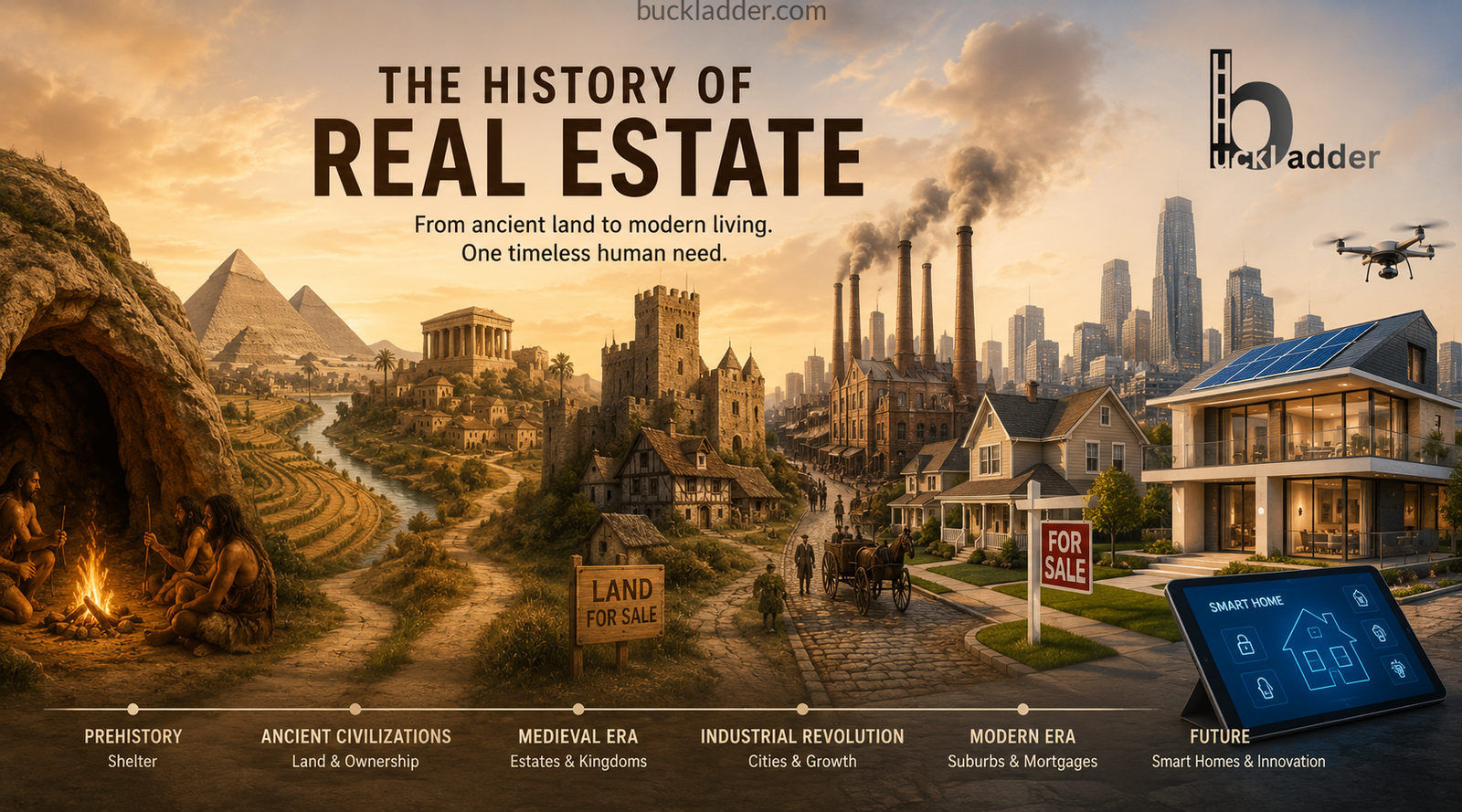
Believe it or not, that’s where the story of real estate begins.
The history of real estate isn’t just about buildings. It’s the story of civilization itself. Every major leap in human history—from farming and kingdoms to skyscrapers and smart homes—changed the way people bought, sold, and valued land.
Let’s travel through thousands of years in just a few minutes.
Chapter 1: When Land Belonged to Everyone
Long before cities existed, humans were hunters and gatherers.
People moved constantly.
If food disappeared…
They moved.
If the weather changed…
They moved.
Land wasn’t something you owned.
It was simply where you happened to be.
Nobody could put up a fence and say,
“This mountain is mine.”
Ownership wasn’t necessary because people weren’t staying in one place.
Chapter 2: Farming Changed Everything
Around 10,000 years ago, humans made one of the biggest discoveries in history:
They could grow food.
Instead of chasing animals across continents, families settled down near rivers and fertile land.
For the first time, location mattered.
If your family cleared a field and planted crops…
You wanted everyone to know it was yours.
That simple idea changed history forever.
Land became valuable.
And where there’s value…
There’s competition.
Chapter 3: The World’s First Real Estate Boom
As villages became towns and towns became cities, land became limited.
Ancient civilizations like Mesopotamia and Egypt developed systems to record land ownership, collect taxes, and settle disputes.
People began buying, selling, and inheriting property.
Some even rented homes.
Sound familiar?
Thousands of years later, we’re still doing the same thing.
Chapter 4: Kings Owned Almost Everything
During the Middle Ages, owning land wasn’t easy.
In many places, kings technically owned nearly all the land.
Nobles were granted estates.
Farmers often worked the land without actually owning it.
Your home, your farm, and even your future could depend on the local ruler.
Owning land wasn’t just about wealth.
It was about power.
The more land you controlled, the more influence you had.
Chapter 5: Cities Started Growing Up
As trade expanded, merchants became wealthier.
People moved into growing cities looking for work.
Houses, shops, warehouses, and markets appeared everywhere.
Real estate was no longer just farmland.
Location inside a busy city suddenly became extremely valuable.
A shop on a crowded street could make far more money than one tucked away in a quiet corner.
Sound familiar?
Today, businesses still pay premium prices for prime locations.
Chapter 6: The Industrial Revolution Changed Housing Forever
The 1700s and 1800s transformed real estate.
Factories created millions of new jobs.
People left farms and moved into cities.
Cities exploded in size.
Apartment buildings appeared.
Entire neighborhoods were built.
For the first time, developers began constructing large numbers of homes instead of individual houses.
Modern real estate development had arrived.
Chapter 7: The Birth of the Suburbs
After World War II, many families dreamed of something new:
A house.
A yard.
A garage.
A quiet neighborhood.
As automobiles became common, people could live farther from city centers and still commute to work.
This gave rise to suburbs—planned communities designed for growing families.
Many of today’s suburban neighborhoods were built during this period.
Chapter 8: Mortgages Changed Everything
Imagine having to pay cash for an entire house.
Very few people could.
Mortgages made homeownership possible for millions of families.
Instead of saving hundreds of thousands of dollars upfront, buyers could spread payments over many years.
This dramatically increased the number of homeowners and reshaped the housing market.
For many people, a home became their largest investment.
Chapter 9: Real Estate Becomes an Investment
At some point, people realized something important.
You didn’t have to live in a property to make money from it.
You could:
- Rent it out.
- Renovate it and sell it.
- Lease commercial space.
- Buy land and wait for it to increase in value.
Real estate evolved from shelter into one of the world’s most popular wealth-building tools.
Today, countless investors earn income from properties they never personally occupy.
Chapter 10: The Housing Crash That Shocked the World
In the early 2000s, home prices rose rapidly in many markets.
People believed prices would continue climbing forever.
Many buyers borrowed more than they could comfortably afford.
When prices fell, millions of homeowners faced financial hardship.
The global financial crisis of 2008 showed an important lesson:
Real estate can create wealth—but it also carries risk.
The event reshaped lending standards, financial regulations, and how many people think about housing.
Chapter 11: The Digital Revolution
Buying a house once meant spending weekends driving around neighborhoods and reading newspaper listings.
Today, you can:
- View thousands of homes online.
- Take virtual tours.
- Compare neighborhoods.
- Estimate property values.
- Apply for financing digitally.
Technology has made buying and selling property faster and more transparent than ever before.
Chapter 12: The Future of Real Estate
The story isn’t over.
The next chapter is already being written.
Emerging trends include:
- Smart homes with connected devices.
- Sustainable and energy-efficient buildings.
- Artificial intelligence helping buyers find properties.
- Remote work changing where people choose to live.
- 3D-printed homes reducing construction costs.
- Modular housing and new building technologies.
The way we live continues to evolve—and real estate evolves with it.
But here’s the most exciting part:
You are not just a reader of this history—you are a potential creator of its next chapter.
Chapter 13: How YOU Could Help Revolutionize Real Estate
Real estate has always changed when people dared to think differently.
Farming changed it.
Cities changed it.
Technology changed it.
And now, it’s your turn to imagine what comes next.
Here are real ways people like you could revolutionize real estate:
1. Build Smarter, More Affordable Housing
Imagine designing homes that cost 50% less to build.
- 3D-printed houses using recycled materials
- Modular homes that snap together like building blocks
- Tiny home communities for affordable living
👉 Example: A startup could create “plug-and-play homes” that families can expand as they grow.
2. Turn Empty Spaces Into Living Communities
Across the world, millions of buildings sit unused.
You could help change that.
- Convert empty offices into apartments
- Transform abandoned malls into housing + coworking hubs
- Reimagine warehouses as creative live-work spaces
👉 Example: A developer could turn a dead shopping mall into a vibrant mini-city with homes, gyms, and schools.
3. Use Technology to Make Buying Homes Fairer
Real estate is often confusing and expensive.
You could simplify it.
- AI tools that predict fair home prices
- Apps that match people to homes based on lifestyle, not just budget
- Blockchain systems for transparent property ownership
👉 Example: A platform that removes hidden fees and shows the true cost of owning a home in real time.
4. Create Climate-Friendly Housing Solutions
The future of real estate must also protect the planet.
- Carbon-neutral homes
- Solar-powered neighborhoods
- Floating or flood-resistant housing in coastal cities
👉 Example: Entire eco-communities that generate more energy than they consume.
5. Redesign How People Live Together
The future may not be single-family homes everywhere.
You could help design new lifestyles:
- Co-living spaces for young professionals
- Multi-generational housing for families
- Community-first neighborhoods with shared gardens and kitchens
👉 Example: A “modern village” where people share resources but still have private homes.
6. Make Real Estate Accessible to Everyone
What if anyone could invest in property—even with $10?
- Fractional ownership platforms
- Tokenized real estate investments
- Global property crowdfunding
👉 Example: A teenager could own a small share of an apartment building and earn rental income.
A New Kind of Real Estate Story
For thousands of years, real estate was shaped by kings, governments, and large institutions.
But today, something is changing.
Technology is lowering barriers.
Creativity is opening doors.
And individuals—people like you—can now influence how homes are built, bought, and lived in.
Final Thoughts
Real estate started with caves.
Then it became farms.
Then cities.
Then skyscrapers.
Then digital marketplaces.
And now, it is entering its most exciting phase yet:
A phase where innovation is no longer limited to governments or billion-dollar companies.
It belongs to anyone with an idea.
So as you think about the history of real estate, don’t just ask:
“How did we get here?”
Ask something bigger:
“What would I change if I could redesign real estate from scratch?”
Because the next revolution in real estate…
Might start with you.