What Is Bitcoin? The Complete History, Mystery, Purpose, and Future of the World’s First Cryptocurrency
Bitcoin has been called many things:
- Digital gold
- Internet money
- A speculative bubble
- A technological revolution
- The future of finance
More than fifteen years after its launch, Bitcoin remains one of the most debated innovations in modern history. It has survived government crackdowns, market crashes, exchange failures, and countless predictions of its demise.
Yet despite becoming a trillion-dollar asset and a household name, many people still ask a surprisingly simple question:
What Is Bitcoin?
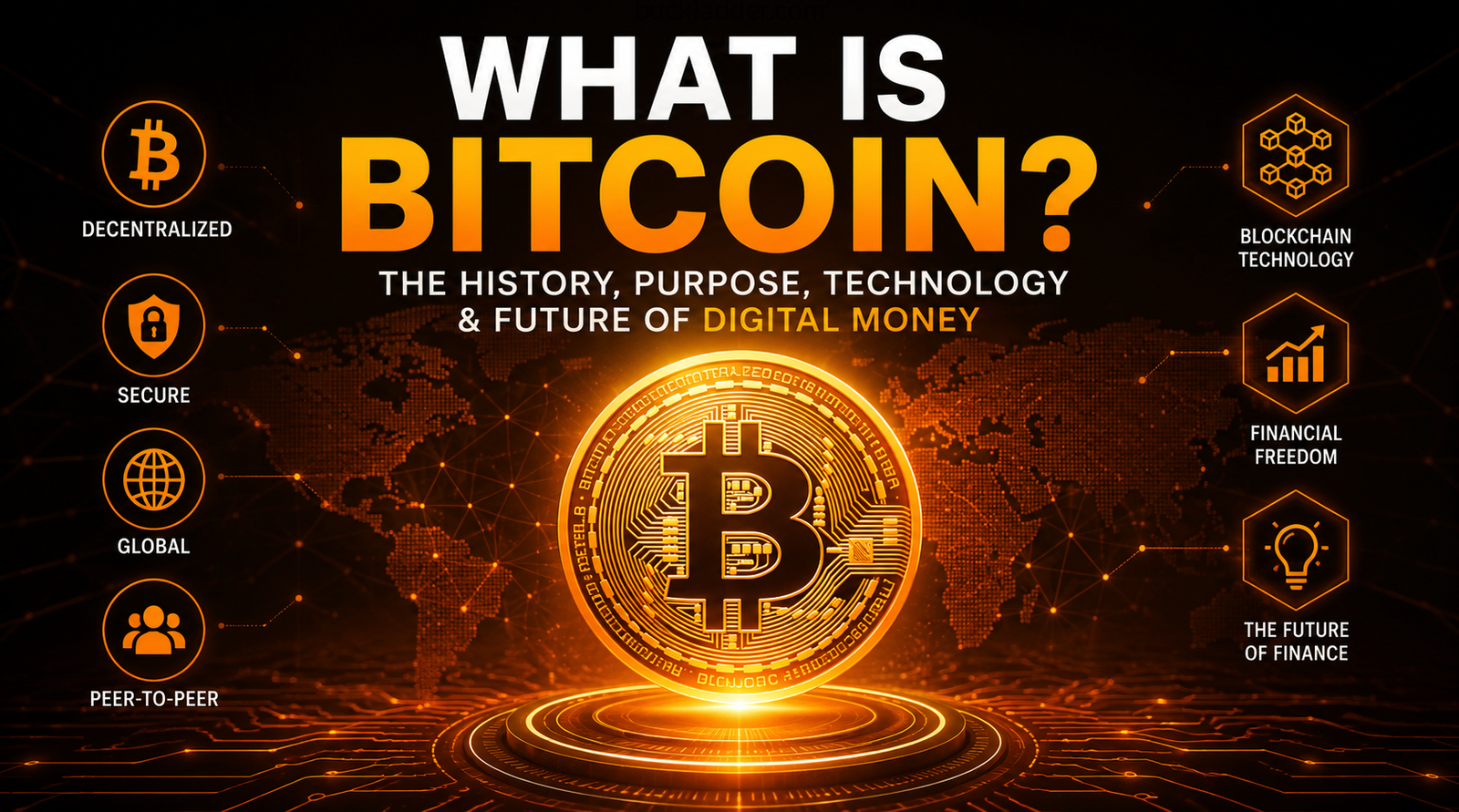
Bitcoin is a decentralized digital currency that operates without a central authority such as a government, bank, or corporation.
Unlike traditional money, Bitcoin exists entirely on a distributed computer network called a blockchain.
This network is maintained by thousands of participants worldwide who verify transactions and secure the system.
Bitcoin allows individuals to send value directly to one another without requiring permission from a bank or payment processor.
Its most important characteristics include:
- Limited supply of 21 million coins
- Global accessibility
- Decentralized operation
- Resistance to censorship
- Transparency through a public ledger
These features make Bitcoin fundamentally different from traditional currencies.
The Problem Bitcoin Was Designed to Solve
To understand Bitcoin’s purpose, consider how modern banking works.
Most electronic transactions involve trusted intermediaries:
- Banks
- Credit card companies
- Payment processors
- Governments
These intermediaries perform important functions, but they also create challenges:
- Transaction fees
- Payment delays
- Account freezes
- Currency debasement through inflation
- Dependence on centralized institutions
The creator of Bitcoin believed it should be possible to transfer value online directly between two parties without relying on a trusted third party.
Bitcoin was designed to solve that problem.
The Financial Crisis That Changed Everything
Bitcoin emerged during one of the most significant financial events in modern history.
The 2008 Global Financial Crisis exposed weaknesses throughout the banking system and fundamentally changed how many people viewed money, banks, and government intervention.
The crisis was years in the making. During the early 2000s, banks and lenders issued large numbers of mortgages, including risky “subprime” loans to borrowers with poor credit histories. These mortgages were bundled into complex financial products and sold to investors around the world.
As housing prices continued rising, many believed the market would never decline significantly. However, when home prices began falling, millions of homeowners found themselves unable to repay their mortgages.
This triggered a chain reaction:
- Mortgage defaults surged.
- Housing prices collapsed.
- Mortgage-backed securities lost value.
- Major financial institutions suffered enormous losses.
- Credit markets froze.
- Businesses and consumers struggled to access financing.
Several major institutions either failed or required government intervention, including:
- Lehman Brothers, which filed for bankruptcy in September 2008.
- Bear Stearns, which was rescued through a government-backed acquisition.
- American International Group (AIG), which received a massive federal bailout.
- Fannie Mae and Freddie Mac, which were placed into government conservatorship.
Governments organized massive bailouts to stabilize the financial system.
Central banks injected unprecedented amounts of money into the economy and lowered interest rates to support economic recovery.
Public trust in traditional financial institutions suffered.
Many people began questioning whether an alternative monetary system—one that did not rely on banks or government intervention—was possible.
Against this backdrop, Bitcoin appeared.
The Birth of Bitcoin
On October 31, 2008, an individual or group using the name Satoshi Nakamoto published a whitepaper titled:
“Bitcoin: A Peer-to-Peer Electronic Cash System.”
The paper outlined a method for creating digital money without requiring trust in a central authority.
On January 3, 2009, the Bitcoin network officially launched.
Embedded within Bitcoin’s first block—the Genesis Block—was a message:
“The Times 03/Jan/2009 Chancellor on brink of second bailout for banks.”
Many view this as a direct reference to the financial crisis and the motivations behind Bitcoin’s creation.
Who Created Bitcoin?
This remains one of the greatest mysteries in technology history.
No one knows with certainty who Satoshi Nakamoto is.
Numerous theories have emerged over the years.
Hal Finney
One of the strongest candidates frequently discussed is Hal Finney.
Finney was a renowned cryptographer and one of Bitcoin’s earliest contributors.
He received the first Bitcoin transaction ever sent by Satoshi.
He possessed the technical expertise required to build Bitcoin and lived near a man coincidentally named Dorian Nakamoto.
However, Finney consistently denied being Satoshi.
Many researchers believe he was an early collaborator rather than Bitcoin’s creator.
Len Sassaman
In recent years, Len Sassaman has become one of the most discussed candidates.
Sassaman was a highly respected cryptographer and privacy advocate deeply involved in the cypherpunk movement.
Supporters of this theory point to:
- His cryptographic expertise
- His writing style similarities
- His privacy-focused philosophy
- His connections within the cypherpunk community
Some researchers argue Sassaman fits the profile better than any other candidate.
However, there remains no definitive proof.
Adam Back
Adam Back is another frequently mentioned possibility.
Back invented Hashcash, a proof-of-work system cited directly in Bitcoin’s whitepaper.
Hashcash became a foundational building block for Bitcoin’s mining process.
Back possesses both the technical knowledge and historical involvement necessary to have created Bitcoin.
Like other candidates, he has repeatedly denied being Satoshi.
David Chaum
Many people mistakenly refer to David Chaum as David Chong.
David Chaum is often called the “Godfather of Digital Cash.”
Long before Bitcoin existed, Chaum developed groundbreaking digital currency concepts, including DigiCash in the 1980s and 1990s.
Although most researchers do not believe Chaum created Bitcoin, his work laid much of the intellectual foundation that eventually made Bitcoin possible.
Without David Chaum’s innovations, Bitcoin might never have existed.
The Most Likely Answer
The truth is that nobody knows.
Satoshi Nakamoto could be:
- One individual
- Multiple developers
- Someone never publicly identified
- Someone already discussed publicly
The mystery remains unsolved.
Ironically, Bitcoin may be stronger because its creator disappeared.
Without a visible founder, there is no CEO, no founder’s influence, and no central figure controlling the network.
The Cypherpunk Movement
Bitcoin did not emerge from nowhere.
It grew from a community known as the Cypherpunks.
Cypherpunks believed:
- Privacy is a fundamental right
- Cryptography can protect freedom
- Individuals should control their own money and information
Many concepts used in Bitcoin were developed by this community decades before Bitcoin’s launch.
In many ways, Bitcoin represents the culmination of decades of cypherpunk experimentation.
How Bitcoin Works
At a high level:
- Users send Bitcoin transactions.
- Transactions are verified by the network.
- Miners compete to secure the blockchain by using computing power to solve complex mathematical puzzles, and the first miner to solve the puzzle earns the right to add the next block to the blockchain.
- Verified transactions are added to new blocks.
- The blockchain records the complete transaction history.
What Does Bitcoin Do Today?
Bitcoin’s role has evolved significantly.
Store of Value
Today, many investors view Bitcoin primarily as digital gold.
Its scarcity makes it attractive as a potential long-term store of value.
Investment Asset
Bitcoin has become one of the most widely owned alternative assets in the world.
Institutional investors, hedge funds, corporations, and individual investors now hold Bitcoin.
International Transfers
Bitcoin enables cross-border transactions without traditional banking infrastructure.
Financial Access
In regions with unstable currencies or limited banking access, Bitcoin can provide an alternative financial system.
Examples include:
- Individuals in countries experiencing hyperinflation, such as Venezuela, using Bitcoin to preserve purchasing power.
- Migrant workers sending money to family members across borders without relying on expensive remittance services.
- People living in regions with limited banking infrastructure, such as Nigeria, gaining access to a global financial network through a smartphone and internet connection.
- Citizens in countries, like Lebanon and Iran, facing capital controls, using Bitcoin to move value internationally when traditional banking options are restricted.
Is Bitcoin Serving Its Intended Purpose?
The answer depends on how you define Bitcoin’s purpose.
Successes
Bitcoin has succeeded as:
- A decentralized monetary network
- A censorship-resistant asset
- A store of value for many investors
- A globally recognized financial asset
Challenges
Bitcoin has been less successful as an everyday payment method.
Challenges include:
- Price volatility
- Transaction fees during periods of congestion
- Regulatory uncertainty
- User experience complexity
Many people currently use Bitcoin more as a savings asset than as daily spending money.
Bitcoin’s Future Outlook
No one knows exactly what Bitcoin’s future holds.
However, several trends are worth monitoring.
Institutional Adoption
Major financial institutions continue integrating Bitcoin into traditional finance.
Examples include:
- BlackRock launching a spot Bitcoin ETF and offering Bitcoin exposure to its clients.
- Fidelity providing Bitcoin custody services and investment products.
- Goldman Sachs and JPMorgan expanding digital asset offerings for institutional clients.
- Public companies such as MicroStrategy accumulating billions of dollars worth of Bitcoin as part of their corporate treasury strategy.
Nation-State Adoption
Some governments have begun exploring Bitcoin reserves and strategic holdings.
- El Salvador became the first country to adopt Bitcoin as legal tender in 2021.
- Bhutan is, reportedly, accumulating Bitcoin through state-backed mining operations powered by hydroelectric energy.
- Discussions in several countries about holding Bitcoin as part of strategic reserves alongside traditional assets are ongoing.
- Municipal and regional governments around the world are exploring Bitcoin-friendly policies to attract investment and innovation.
ETF Growth
Bitcoin ETFs have made ownership more accessible to traditional investors.
Examples include:
- The approval of spot Bitcoin ETFs in the United States in 2024.
- Products from BlackRock, Fidelity, Ark Invest, Bitwise, and other major asset managers attracting billions of dollars in inflows.
- Investors gaining Bitcoin exposure through traditional brokerage accounts without needing to manage private keys or cryptocurrency wallets.
- Increased participation from retirement accounts, financial advisors, and institutional investors.
Digital Gold Narrative
The comparison between Bitcoin and gold continues to gain traction among investors seeking scarce assets.
Supporters argue that Bitcoin shares several characteristics with gold:
- Scarcity
- Durability
- Portability
- Divisibility
- Resistance to debasement
Potential Risks
Bitcoin also faces challenges:
- Regulation
- Technological competition
- Security concerns
- Political opposition
- Market volatility
Who Should Consider Bitcoin as an Investment?
Bitcoin may be appropriate for:
Long-Term Investors
Individuals with multi-year investment horizons often find Bitcoin’s long-term growth potential attractive.
Diversified Investors
Bitcoin can serve as a small component within a diversified portfolio.
Investors Comfortable With Volatility
Bitcoin regularly experiences large price swings.
Investors must be prepared for significant fluctuations.
Who May Want to Avoid Bitcoin?
Bitcoin may not be suitable for:
- Short-term speculators seeking certainty
- Investors with low risk tolerance
- People who may need immediate access to invested funds
- Anyone uncomfortable with substantial volatility
Final Thoughts
Bitcoin began as an obscure experiment created by an anonymous developer during a global financial crisis.
Today, it stands as one of the most important financial innovations of the 21st century.
Its creator remains unknown.
Its future remains uncertain.
Yet Bitcoin has already achieved something remarkable: it introduced the world to the idea that money can exist independently of governments, banks, and corporations.
Whether Bitcoin ultimately becomes a global reserve asset, digital gold, or something entirely different, its impact on finance, technology, and society is likely to be studied for generations to come.