The History of Bonds: How an Ancient Promise to Repay Money Built the Modern World
The World’s Most Powerful Piece of Paper
Imagine someone handed you a piece of paper that simply said:
“I promise to pay you back—with interest.”
It doesn’t sound very exciting.
Yet that simple promise has financed:
- The Roman Empire
- Great cathedrals
- Entire wars
- Railroads
- Skyscrapers
- Space exploration
- Highways
- Schools
- Hospitals
That promise is called a bond.
And without bonds, the modern world might look completely different.
Before Banks, Before Stock Markets…
Let’s travel back nearly 5,000 years.
There were:
❌ No banks.
❌ No stock exchanges.
❌ No smartphones telling you your portfolio is down 2%.
Yet people still needed money.
Kings needed armies.
Farmers needed seeds.
Merchants needed ships.
Someone always needed cash.
Someone else had savings.
That simple problem created one of humanity’s oldest financial inventions.
Ancient Mesopotamia: The First Recorded Loans
Around 3000 BC, merchants in Mesopotamia—located in present-day Iraq—recorded loans on clay tablets.
These weren’t bonds exactly as we know them today.
But they followed the same basic idea:
“I’ll borrow money today…”
“…and repay you later.”
Some agreements even included interest payments.
Finance had officially been born.
Ancient Rome: Financing an Empire
As the Roman Empire expanded, it needed enormous amounts of money.
Roads.
Aqueducts.
Military campaigns.
Public buildings.
Taxes helped—but they weren’t always enough.
Governments increasingly relied on borrowing to finance large projects and manage expenses.
The principle behind modern government bonds was beginning to take shape.
The Middle Ages: Borrowing Gets Smarter
Fast forward to medieval Europe.
Kings constantly needed money.
Sometimes for castles.
Sometimes for wars.
Sometimes because they had simply spent too much.
Rather than raising taxes overnight, rulers began borrowing from wealthy merchants and banking families.
These lenders expected something in return:
Interest.
Sound familiar?
That’s essentially what bond investing is today.
The Italian City-States Changed Everything
Around the 12th and 13th centuries, cities like Venice, Florence, and Genoa transformed public borrowing.
Instead of relying on a handful of wealthy lenders, governments began borrowing from many citizens.
People could purchase government debt and receive regular payments.
For the first time, borrowing became organized, transferable, and more accessible.
Many historians consider this the foundation of the modern bond market.
Wars Made Bonds Famous
Here’s something surprising.
Some of history’s biggest wars were financed with bonds.
Governments needed massive amounts of money—quickly.
Instead of waiting years to collect taxes, they asked citizens and investors to lend money.
Many countries issued war bonds, encouraging people to support the national effort while earning interest.
It was one of the earliest examples of millions of ordinary people becoming investors.
The Birth of Government Bonds
As countries grew, governments realized bonds offered several advantages.
Instead of shocking citizens with huge tax increases, they could:
- Borrow money today.
- Build infrastructure immediately.
- Repay the debt over many years.
This approach helped finance:
- Roads
- Canals
- Bridges
- Railways
- Public buildings
- Schools
Even today, governments around the world continue to use bonds for these purposes.
Then Came the Industrial Revolution
The 1800s changed everything.
Factories appeared.
Railroads stretched across continents.
Steamships connected global trade.
Electricity transformed cities.
But all of these innovations required one thing:
Money.
Lots of it.
Companies began issuing corporate bonds to raise capital from investors rather than relying solely on banks.
This allowed businesses to grow much faster than before.
Wall Street Enters the Picture
As financial markets expanded, buying and selling bonds became easier.
Investors no longer had to hold a bond until it matured.
They could sell it to someone else.
This created a secondary market, making bonds more flexible and attractive.
Soon, governments, corporations, banks, pension funds, and individual investors were all participating.
The bond market had become a global financial powerhouse.
Bonds Helped Build the Modern World
Think about the infrastructure around you.
Your local airport.
A major bridge.
A subway system.
A university campus.
A water treatment plant.
A hospital.
There’s a good chance bonds helped finance at least part of it.
Many of the conveniences we take for granted today were built with borrowed money raised through bond markets.
The Rise of Individual Investors
For much of history, bond investing was dominated by governments, wealthy families, and large institutions.
Today, almost anyone can invest in bonds through:
- Individual government bonds
- Corporate bonds
- Municipal bonds
- Bond mutual funds
- Bond ETFs
- Retirement accounts
What was once reserved for the wealthy is now available to everyday investors.
The Bond Market Today
The modern bond market is one of the largest financial markets in the world.
Every day, governments and companies raise billions of dollars through bond issuance.
Investors range from college graduates investing their first paycheck to pension funds managing billions of dollars for retirees.
Bonds remain one of the world’s primary ways of connecting people who have money with organizations that need it.
Five Amazing Bond Facts
1. Bonds Are Older Than Most Countries
The concept of lending money for repayment dates back thousands of years.
2. Bonds Helped Finance Entire Nations
Many countries relied on bonds to build infrastructure and navigate major historical events.
3. The Bond Market Is Enormous
Globally, the bond market is measured in the hundreds of trillions of dollars.
4. Governments Still Depend on Bonds
Modern governments regularly issue bonds to fund long-term projects and manage public finances.
5. Many Retirements Depend on Bonds
Pension funds, insurance companies, and retirees often rely on bonds for steady income and portfolio stability.
How Bonds Changed Everyday Life
Without bonds, many things we enjoy today might have taken much longer to build—or might never have been built at all.
Consider:
- Interstate highways
- Public schools
- Airports
- Hospitals
- Renewable energy projects
- Research facilities
- Public transportation
Behind many of these achievements is a simple financial promise to repay borrowed money over time.
Common Myths About Bond History
Myth: Bonds Are a Modern Financial Invention.
Reality: The practice of borrowing and repaying with interest dates back thousands of years.
Myth: Bonds Are Only for Governments.
Reality: Companies, municipalities, and other organizations also issue bonds to finance projects and growth.
Myth: Bonds Are Boring.
Reality: Their history is filled with wars, empires, innovation, economic transformation, and the construction of civilizations.
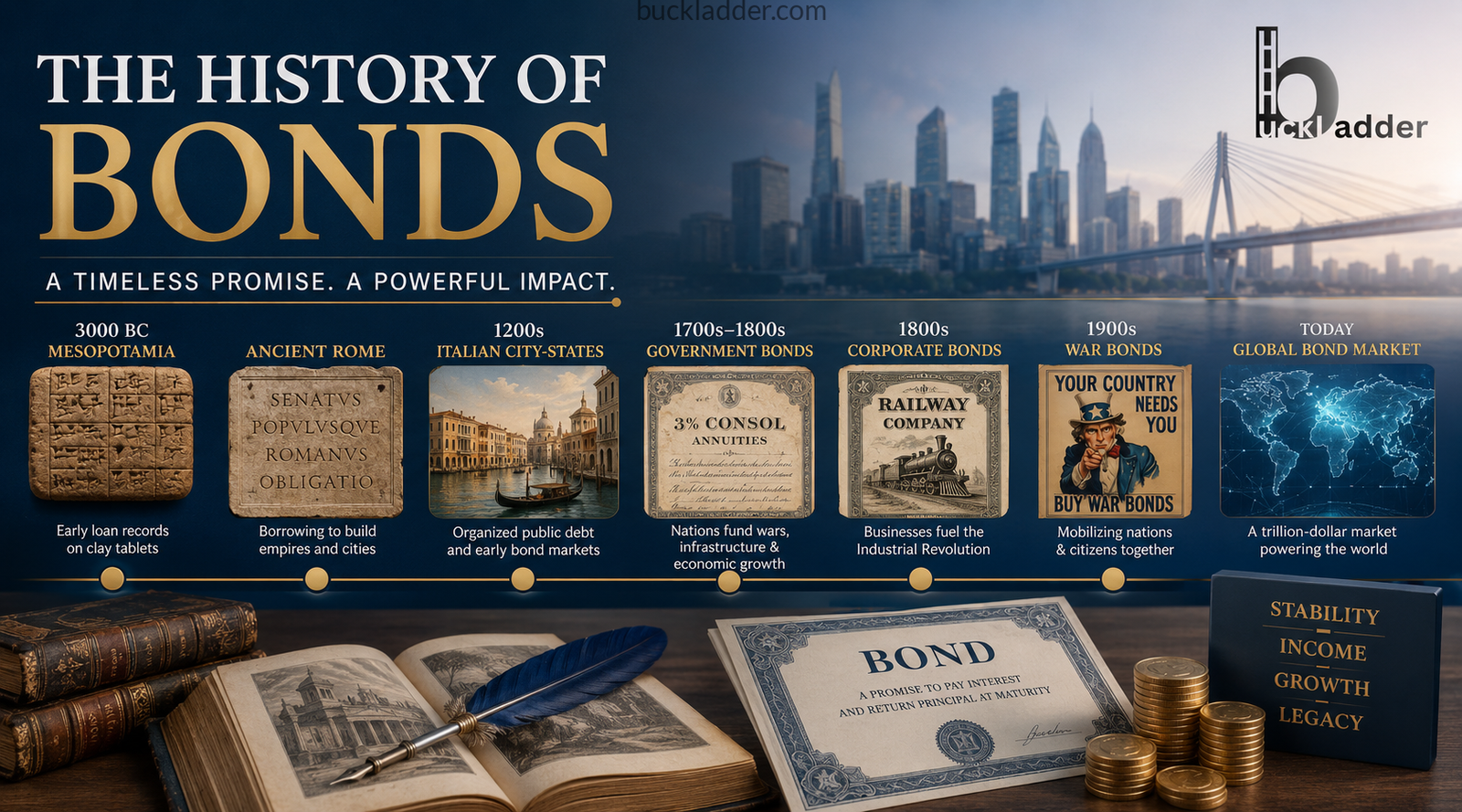
Timeline of Bond History
3000 BC – Early loan agreements recorded in Mesopotamia.
Ancient Rome – Borrowing supports public works and military expansion.
1100s–1300s – Italian city-states develop organized public debt systems.
1700s–1800s – Governments increasingly issue bonds to finance national development.
1800s – Corporate bonds fuel the Industrial Revolution.
1900s – War bonds become widely used during global conflicts.
Today – The bond market is a cornerstone of the global financial system.
Final Thoughts
The history of bonds isn’t just the story of finance—it’s the story of civilization.
For thousands of years, bonds have allowed societies to solve a timeless problem: how to build today using tomorrow’s resources.
Every bridge crossed, airport visited, business expanded, or school constructed through borrowed capital is part of that story.
So the next time someone says bonds are “boring,” remember this:
They may look like simple promises on paper, but they’ve helped shape the world we live in.