Stocks vs. ETFs: Which Should Beginners Choose?
One of the biggest decisions new investors face is whether to invest in individual stocks or Exchange-Traded Funds (ETFs).
Both can help you build wealth, but they do so in different ways.
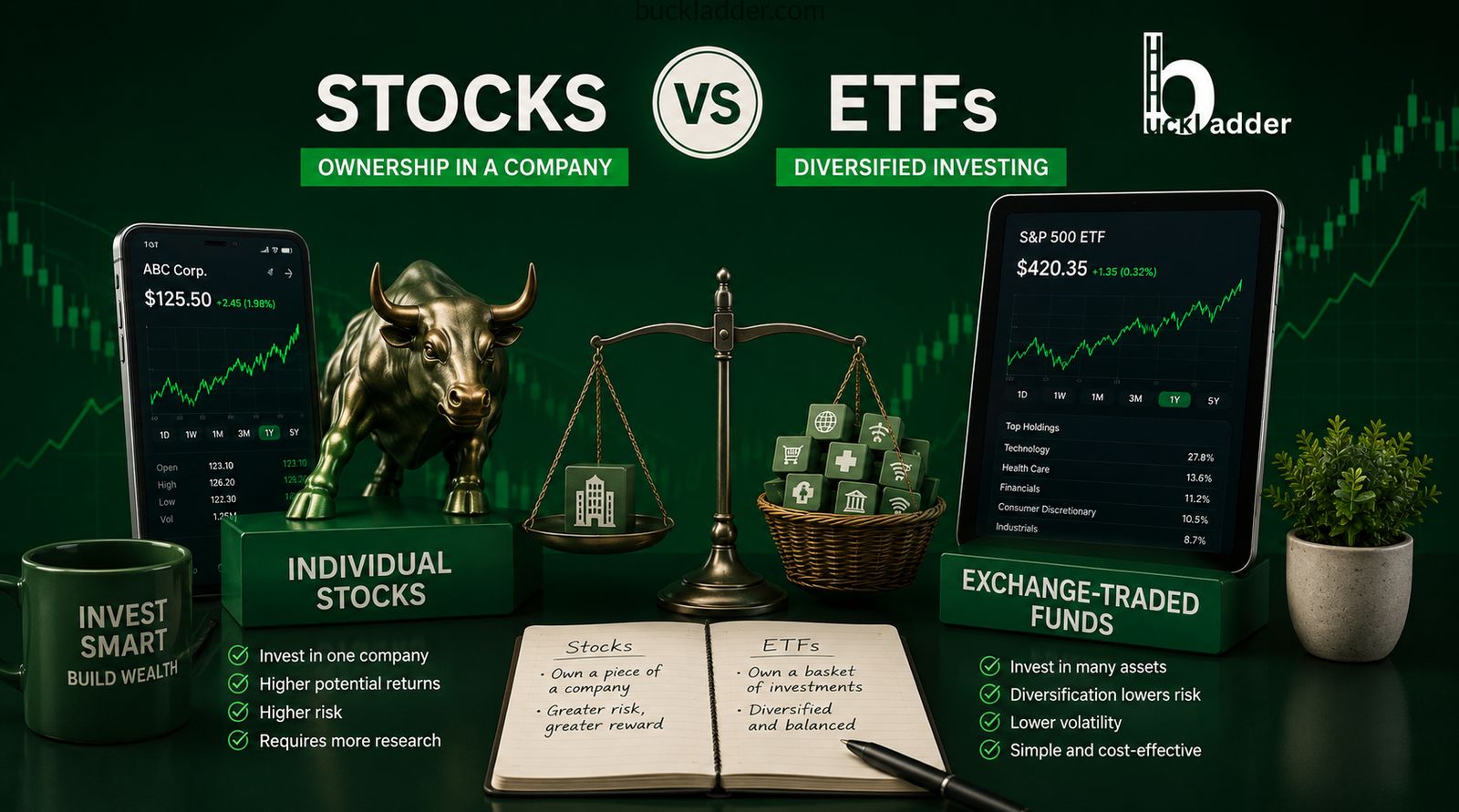
Buying an individual stock means owning a piece of one company. Buying an ETF means purchasing a single investment that can hold dozens, hundreds, or even thousands of different stocks or bonds.
For beginners, understanding these differences can make the difference between building a stable portfolio and taking on unnecessary risk.
What Is a Stock?
A stock represents partial ownership in a single company.
When you purchase shares of a company, your investment’s value depends largely on how that company performs.
For example, if you purchase shares of a technology company and its profits increase over several years, the share price may rise significantly. If the company struggles financially, your investment could lose value.
Example
Suppose you buy:
- 100 shares
- Price per share: $40
Investment:
100 × $40 = $4,000
If the stock later rises to $60:
100 × $60 = $6,000
Profit:
$6,000 − $4,000 = $2,000
However, if the stock falls to $25, your investment becomes only $2,500.
What Is an ETF?
ETF stands for Exchange-Traded Fund.
An ETF is a basket of investments that trades on a stock exchange just like an individual stock.
Instead of buying one company, you’re buying many investments simultaneously.
An ETF may include:
- Hundreds of stocks
- Government bonds
- Corporate bonds
- Commodities
- International companies
- Real estate investment trusts (REITs)
Because ETFs contain multiple investments, they help spread risk through diversification.
How ETFs Work
Imagine an ETF that tracks the S&P 500.
Instead of buying shares in 500 individual companies one by one, purchasing a single share of the ETF gives you exposure to all of them in proportion to the fund’s design.
This makes investing much simpler for beginners.
Key Differences Between Stocks and ETFs
| Feature | Stocks | ETFs |
|---|---|---|
| Number of Companies | One | Many |
| Diversification | Low | High |
| Risk | Higher | Lower |
| Potential Returns | Higher | Moderate to High |
| Research Required | Extensive | Minimal |
| Management | Self-selected | Professionally managed or index-based |
| Trading | Throughout the day | Throughout the day |
| Dividends | Some companies | Many ETFs distribute dividends |
| Beginner Friendliness | Moderate | Excellent |
Diversification Explained
Diversification simply means not putting all your eggs in one basket.
Individual Stock Example
You invest $10,000 into one company.
If the stock drops 40%:
Portfolio value:
$10,000 × 60% = $6,000
Loss:
$4,000
ETF Example
Suppose the ETF owns 500 companies.
If one company drops 40%, the overall ETF may decline only a small amount because the other companies help offset the loss.
This is one reason many financial professionals recommend ETFs for new investors.
Risk Comparison
Individual Stocks
Risks include:
- Poor management
- Competition
- Product failures
- Lawsuits
- Economic downturns
- Bankruptcy
One bad company can significantly hurt your portfolio.
ETFs
ETFs still experience market risk, but diversification reduces the impact of problems affecting any single company.
If one business performs poorly, hundreds of others may continue performing well.
Return Potential
Historically, carefully selected individual stocks can outperform ETFs.
However, consistently identifying winning stocks is difficult—even for professional investors.
Broad-market ETFs have historically delivered strong long-term returns while requiring much less research and maintenance.
Costs
Stocks
When buying individual stocks, investors typically don’t pay ongoing management fees, though brokerage commissions or trading costs may apply depending on the platform.
ETFs
Most ETFs charge an expense ratio, which is an annual management fee.
Example:
Investment:
$10,000
Expense ratio:
0.05%
Annual cost:
$10,000 × 0.0005 = $5
Many index ETFs have very low expense ratios.
Types of ETFs
There are ETFs for nearly every investment strategy.
Index ETFs
Track broad market indexes.
Examples:
- S&P 500
- Total Stock Market
- International Markets
Sector ETFs
Focus on industries such as:
- Technology
- Healthcare
- Financials
- Energy
- Consumer Goods
Dividend ETFs
Invest primarily in companies that regularly pay dividends.
Suitable for investors seeking income.
Bond ETFs
Hold portfolios of government or corporate bonds.
Often used to reduce portfolio volatility.
International ETFs
Provide exposure to companies outside your home country.
These can increase diversification across global markets.
Which Investment Requires More Research?
Individual stocks require considerably more research.
Before investing, many investors analyze:
- Revenue growth
- Earnings
- Profit margins
- Debt levels
- Management quality
- Industry competition
- Valuation metrics
ETF investors generally only need to understand:
- What the ETF tracks
- Its expense ratio
- Historical performance
- Risk profile
Real-World Example
Suppose two friends each invest $20,000.
Sarah
Buys shares in four individual companies.
If one company loses 60% of its value, her portfolio may experience significant losses.
James
Purchases a diversified total-market ETF.
Although some companies decline, others perform well, reducing the overall impact.
James experiences a smoother investment journey despite market volatility.
Who Should Choose Individual Stocks?
Stocks may be appropriate for investors who:
- Enjoy researching companies
- Can tolerate higher volatility
- Have long investment horizons
- Want the possibility of outperforming the overall market
Who Should Choose ETFs?
ETFs are often ideal for investors who:
- Are just starting
- Want instant diversification
- Prefer a hands-off approach
- Have limited time for research
- Are investing for retirement or long-term wealth
Can You Own Both?
Absolutely.
Many successful investors combine both.
Example Portfolio:
- 80% diversified ETFs
- 20% carefully selected individual stocks
This approach allows investors to enjoy diversification while still pursuing higher returns through select companies.
Common Beginner Mistakes
Buying Popular Stocks Without Research
Popularity alone is not an investment strategy.
Owning Too Few Stocks
A portfolio of one or two companies carries substantial risk.
Ignoring ETF Fees
While many ETFs are inexpensive, comparing expense ratios remains important.
Chasing Recent Performance
The best-performing investment this year may not remain the best next year.
Long-term consistency usually matters more than short-term excitement.
Timeline: Building Your First Investment Portfolio
Week 1
Learn investing basics.
Week 2
Open a brokerage account.
Week 3
Research several broad-market ETFs and a few companies you understand.
Week 4
Invest your first amount.
Every Month
Add new investments consistently.
Every Year
Review and rebalance your portfolio if needed.
Stocks vs. ETFs Scorecard
| Category | Stocks | ETFs |
|---|---|---|
| Growth Potential | 10/10 | 8/10 |
| Diversification | 3/10 | 10/10 |
| Risk | High | Moderate |
| Research Required | High | Low |
| Beginner Friendliness | 7/10 | 10/10 |
| Long-Term Wealth Building | 10/10 | 10/10 |
| Income Potential | 8/10 | 8/10 |
| Time Commitment | High | Low |
Frequently Asked Questions
Are ETFs safer than stocks?
Generally, yes. Because ETFs typically hold many investments, they spread risk across multiple companies or assets. However, ETFs can still lose value during broad market downturns.
Can ETFs outperform individual stocks?
A diversified ETF is unlikely to outperform the very best-performing individual stocks, but it has historically outperformed many investors who try to pick stocks because it reduces the risk of choosing poor performers.
Can I lose money in an ETF?
Yes. ETFs are subject to market risk, and their value can decline. The level of risk depends on the assets the ETF holds.
Should beginners start with ETFs?
For many beginners, broad-market ETFs are an excellent starting point because they provide instant diversification, require less research, and support a long-term investment approach.
Final Thoughts
Both stocks and ETFs are valuable tools for building wealth, but they serve different purposes. Individual stocks offer the possibility of higher returns if you select successful companies, but they also come with greater risk and require more research. ETFs provide broad diversification, lower maintenance, and a smoother investing experience, making them a strong choice for many new investors.
For most beginners, starting with diversified ETFs while gradually learning how to analyze individual companies offers a practical path to becoming a confident, long-term investor.