Crypto Volatility: Why Cryptocurrency Prices Rise and Fall So Dramatically
One of the first things people notice about cryptocurrency is how quickly prices can change. A coin can gain 20% in a day, lose 30% the next week, and then surge to new highs months later. These dramatic price swings are known as volatility, and they are one of the defining characteristics of the cryptocurrency market.
For some investors, volatility is exciting because it creates opportunities for significant gains. For others, it can be intimidating and stressful. Understanding why cryptocurrencies are so volatile can help investors make more informed decisions and avoid emotional reactions during market turbulence.
What Is Volatility?
Volatility refers to the degree to which the price of an asset fluctuates over time. An asset that experiences large and frequent price movements is considered highly volatile.
For example, a traditional savings account may experience virtually no volatility because the value remains stable. A stock may move a few percentage points in a day. By comparison, cryptocurrencies such as Bitcoin and Ethereum can experience double-digit percentage moves within hours.
Volatility itself is neither good nor bad. It simply measures how much prices move. However, higher volatility generally means higher risk and potentially higher rewards.
Why Is Crypto So Volatile?
1. The Market Is Still Young
Compared to traditional financial markets, cryptocurrency is a relatively new asset class.
Stock markets have existed for centuries and are supported by extensive regulations, institutional participation, and mature infrastructure. Cryptocurrency, on the other hand, has only been around since the launch of Bitcoin in 2009.
Because the market is still developing, prices are more sensitive to investor sentiment, news events, and changing expectations.
2. Supply and Demand Drive Prices
Unlike many traditional assets, most cryptocurrencies do not generate cash flow, earnings, or dividends.
As a result, prices are primarily determined by supply and demand. When more people want to buy than sell, prices rise. When more people want to sell than buy, prices fall.
This simple dynamic can create significant swings when investor sentiment changes quickly.
3. News Has an Outsized Impact
Cryptocurrency markets react strongly to news.
Examples include:
- Government regulations
- Exchange hacks
- New technology developments
- Institutional adoption
- Economic uncertainty
- Celebrity endorsements
A single announcement can trigger billions of dollars in buying or selling activity within hours.
4. Leverage Amplifies Movements
Many crypto traders use borrowed money, known as leverage, to increase their potential profits.
While leverage can magnify gains, it also magnifies losses. When prices move sharply, leveraged positions may be automatically liquidated, creating a cascade of forced buying or selling.
This can accelerate volatility and lead to rapid market moves.
5. Cryptocurrency Trades 24/7
Unlike stock markets that close overnight and on weekends, cryptocurrency markets operate around the clock.
Prices can move at any time, including while investors are sleeping.
Because there is no market close, news and events are reflected in prices immediately, contributing to continuous volatility.
6. Smaller Market Size
Although the cryptocurrency market has grown substantially, it remains much smaller than global stock, bond, and real estate markets.
Because of this, large investors can sometimes have a greater influence on prices than they would in larger financial markets.
A significant purchase or sale by a major holder can move prices noticeably.
Is Volatility a Bad Thing?
Not necessarily.
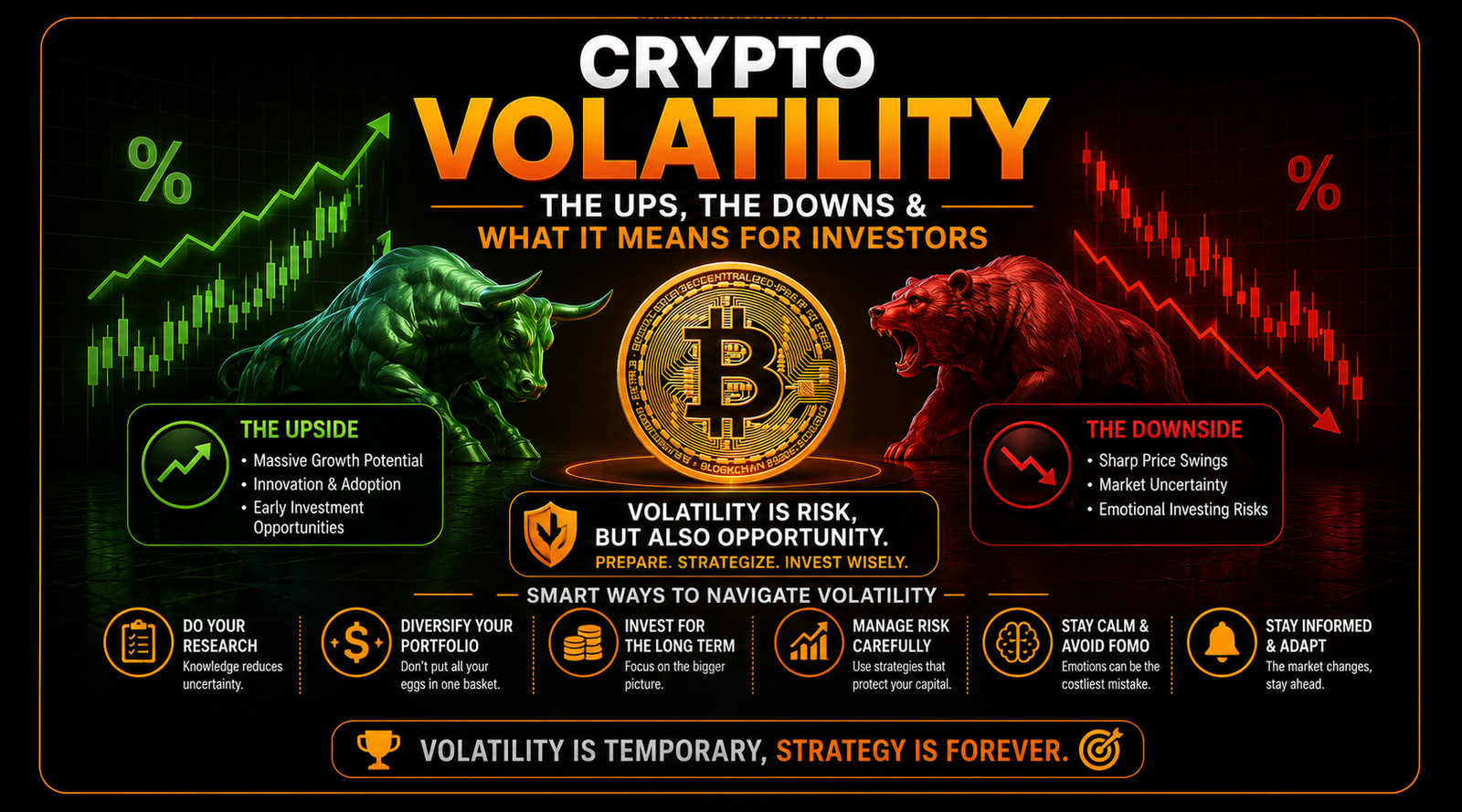
Volatility creates both risks and opportunities.
For traders, volatility can provide chances to profit from price movements.
For long-term investors, volatility can create opportunities to buy assets at lower prices during market downturns.
However, volatility can also lead to significant losses if investors panic, use excessive leverage, or invest money they cannot afford to lose.
Bitcoin’s History of Volatility
Bitcoin provides numerous examples of volatility throughout its history.
Over the years, Bitcoin has experienced multiple declines of more than 50%, only to later recover and reach new all-time highs.
These cycles have become a common feature of the cryptocurrency market.
While past performance does not guarantee future results, Bitcoin’s history demonstrates that large price swings are normal in the crypto ecosystem.
How Investors Can Manage Crypto Volatility
Invest Only What You Can Afford to Lose
Cryptocurrency remains a high-risk investment. Investors should never commit funds they may need for essential expenses.
Diversify
Avoid placing all of your money into a single cryptocurrency.
Diversification can help reduce risk and limit the impact of any one asset’s performance.
Think Long-Term
Many successful investors focus on long-term trends rather than short-term price movements.
Trying to predict daily market swings can be extremely difficult.
Avoid Emotional Decisions
Fear and greed often drive poor investment decisions.
Having a clear investment plan can help investors stay disciplined during periods of extreme volatility.
Consider Dollar-Cost Averaging
Dollar-cost averaging involves investing a fixed amount at regular intervals regardless of price.
This strategy can reduce the impact of short-term volatility and remove some of the emotion from investing.
The Future of Crypto Volatility
As cryptocurrency adoption continues to grow, some experts believe volatility may gradually decrease.
Greater institutional participation, improved regulations, broader adoption, and increased market maturity could lead to more stable pricing over time.
However, volatility is likely to remain a characteristic of cryptocurrency for the foreseeable future.
Investors should view volatility not as a flaw of crypto, but as an inherent feature of an emerging asset class.
Final Thoughts
Volatility is one of the most important concepts every cryptocurrency investor should understand. While dramatic price swings can be unsettling, they are a natural consequence of a young market driven by supply, demand, innovation, and speculation.
Successful crypto investors recognize that volatility is part of the journey. Rather than reacting emotionally to every price movement, they focus on education, risk management, and long-term goals.
In the world of cryptocurrency, volatility is not the exception—it is the norm.