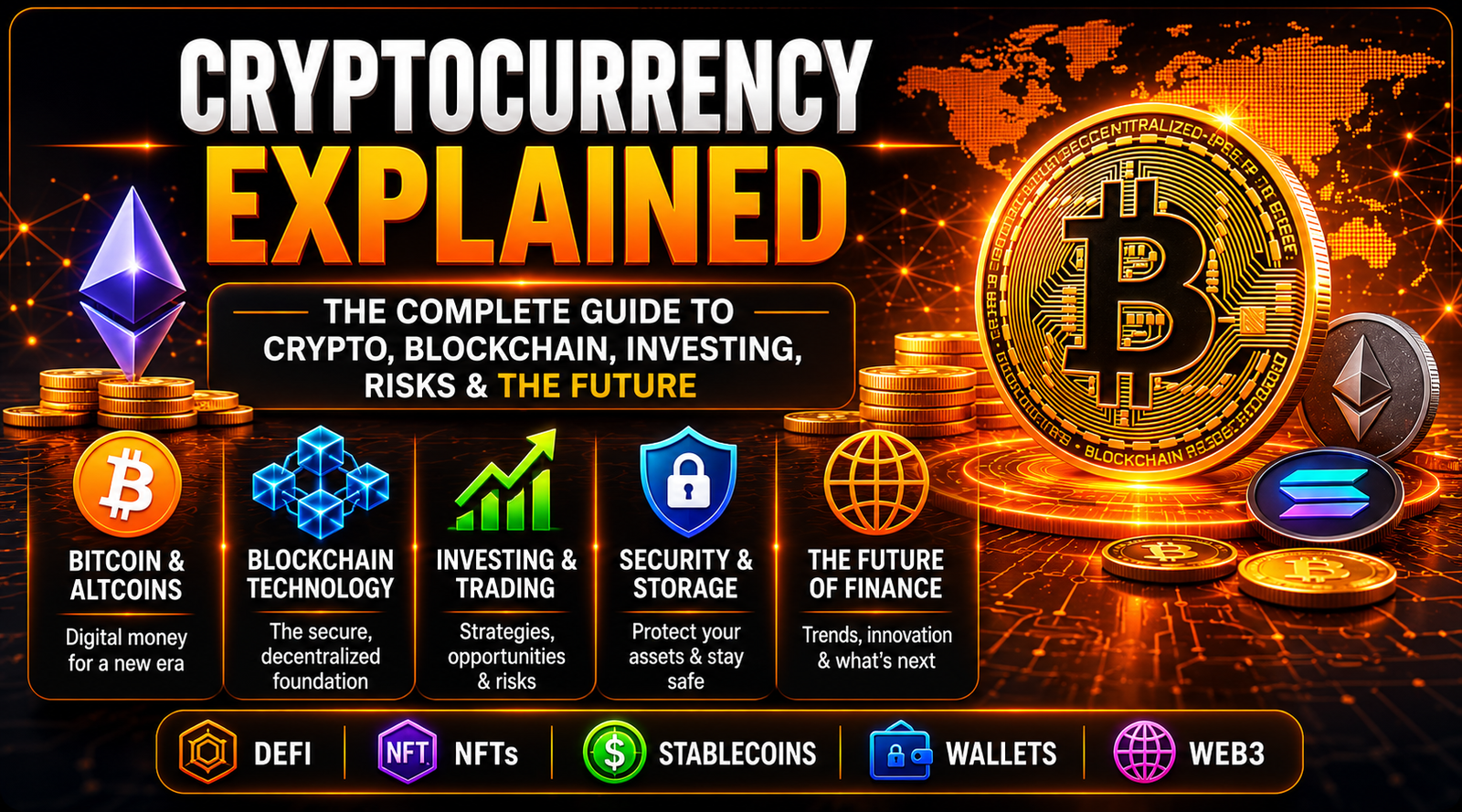
Cryptocurrency Explained: Everything You Need to Know About Crypto, Blockchain, Bitcoin, Investing, Risks, and the Future
Cryptocurrency has become one of the most disruptive innovations of the 21st century.
Supporters believe it could transform money, banking, investing, ownership, and even the internet itself. Critics argue that it remains speculative, volatile, and far from replacing traditional financial systems.
Regardless of where you stand, cryptocurrency has already changed the world.
Since Bitcoin’s creation in 2009, the crypto industry has grown from a niche experiment among programmers into a multi-trillion-dollar global ecosystem that includes investors, governments, banks, corporations, developers, and everyday users.
But what exactly is cryptocurrency, how does it work, why was it created, and where is it headed?
This guide covers everything you need to know.
What Is Cryptocurrency?
Cryptocurrency is a digital asset that uses cryptography and blockchain technology to record transactions and secure ownership.
Unlike traditional currencies such as the U.S. dollar, euro, or Japanese yen, cryptocurrencies generally operate on decentralized networks rather than being issued and controlled by central banks.
Most cryptocurrencies allow users to:
- Send money globally
- Store value digitally
- Participate in decentralized applications
- Trade assets without traditional intermediaries
- Access financial services through blockchain networks
At its core, cryptocurrency represents a new way to transfer, store, and verify value online.
The History of Cryptocurrency
Although Bitcoin launched in 2009, the ideas behind cryptocurrency are much older.
The Foundations
Throughout the 1980s and 1990s, cryptographers sought ways to create digital cash systems.
Notable contributors included:
- David Chaum (DigiCash)
- Wei Dai (b-money)
- Nick Szabo (Bit Gold)
- Adam Back (Hashcash)
- Hal Finney (Reusable Proofs of Work)
These early projects introduced concepts that would eventually become building blocks for Bitcoin.
Bitcoin Changes Everything
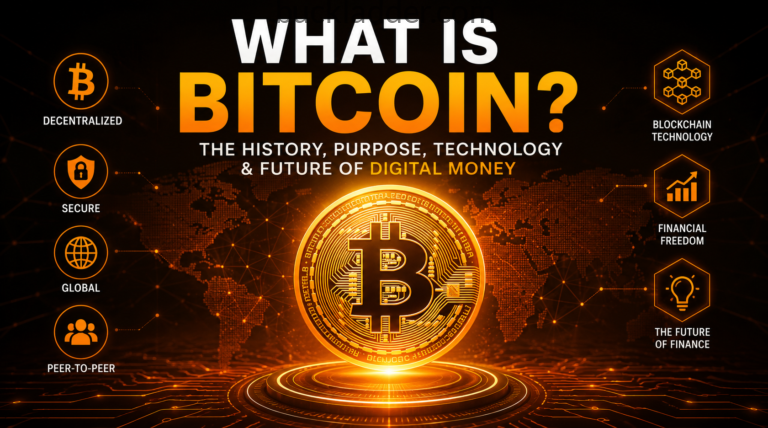
In October 2008, a person or group using the name Satoshi Nakamoto published the Bitcoin whitepaper.
The paper introduced a solution to a problem that had challenged computer scientists for decades:
How can digital money be transferred without requiring trust in a central authority?
On January 3, 2009, Bitcoin launched.
The cryptocurrency era had begun.
What Is Blockchain?
A blockchain is a distributed digital ledger.
Think of it as a public database shared across thousands of computers.
Every transaction is recorded in blocks.
These blocks are linked together chronologically, creating a chain of information that is extremely difficult to alter.
Blockchain technology provides:
- Transparency
- Security
- Immutability
- Decentralization
Without blockchain technology, cryptocurrency would not be possible.
How Does Cryptocurrency Work?
While each cryptocurrency operates differently, most follow a similar process.
Step 1: A Transaction Is Created
A user sends cryptocurrency from one wallet to another.
Step 2: The Network Verifies the Transaction
Computers within the network verify the transaction.
Step 3: Consensus Is Reached
The network agrees that the transaction is valid.
Step 4: The Blockchain Updates
The verified transaction becomes part of the blockchain’s permanent record.
This process occurs without requiring a bank, credit card company, or payment processor.
The Different Types of Cryptocurrencies
Today, there are thousands of cryptocurrencies.
They generally fall into several categories.
Bitcoin
Bitcoin was the first cryptocurrency and remains the largest by market capitalization.
Many investors view it as digital gold.
Smart Contract Platforms
These blockchains allow developers to build applications.
Examples include:
- Ethereum
- Solana
- Avalanche
- Cardano
- Sui
Stablecoins
Stablecoins are designed to maintain stable value.
Examples include:
- USDT
- USDC
- DAI
Utility Tokens
These tokens provide access to services within blockchain ecosystems.
Examples include:
- Chainlink (LINK), which is used to pay for decentralized data services
- Basic Attention Token (BAT), which powers rewards within the Brave browser ecosystem
- Filecoin (FIL), which is used to purchase decentralized cloud storage
- Render (RNDR), which provides access to decentralized GPU rendering services
Governance Tokens
Governance tokens allow holders to vote on protocol decisions.
Examples include:
- Uniswap (UNI)
- Aave (AAVE)
- Maker (MKR)
- Compound (COMP)
Token holders can participate in decisions regarding upgrades, treasury management, and protocol rules.
Meme Coins
These cryptocurrencies often originate from internet culture and community enthusiasm.
Examples include:
- Dogecoin
- Shiba Inu
- Pepe
What Is Decentralized Finance (DeFi)?
DeFi refers to financial services built on blockchain networks.
Instead of relying on banks, DeFi protocols use smart contracts.
Users can:
- Borrow money
- Lend money
- Earn interest
- Trade assets
- Provide liquidity
All without traditional financial intermediaries.
Popular DeFi platforms include:
- Uniswap (decentralized trading)
- Aave (lending and borrowing)
- MakerDAO (stablecoin creation)
- Curve Finance (stablecoin trading)
- Compound (crypto lending)
For example, a user can deposit cryptocurrency into Aave and earn interest, or swap tokens directly through Uniswap without using a centralized exchange.
What Are NFTs?
NFT stands for Non-Fungible Token.
Unlike Bitcoin, where each unit is interchangeable, NFTs represent unique digital ownership.
NFTs have been used for:
- Digital art
- Gaming assets
- Music rights
- Event tickets
- Membership programs
- Intellectual property
Popular NFT collections and projects include:
- Bored Ape Yacht Club (BAYC)
- CryptoPunks
- Pudgy Penguins
- Azuki
- NBA Top Shot
While NFT speculation has cooled since its peak, the technology continues evolving and finding new use cases in gaming, entertainment, and digital identity.
What Are DAOs?
DAO stands for Decentralized Autonomous Organization.
A DAO is an internet-native organization governed by token holders rather than traditional management structures.
Members can vote on:
- Treasury decisions
- Protocol upgrades
- Governance proposals
- Community initiatives
Examples of well-known DAOs include:
- MakerDAO
- Uniswap DAO
- Aave DAO
- Arbitrum DAO
- ENS DAO (Ethereum Name Service)
These organizations allow communities to collectively manage billions of dollars in assets and make decisions through transparent on-chain voting systems.
DAOs represent one of the most interesting experiments in organizational design.
Why Do People Invest in Crypto?
Investors are attracted to cryptocurrency for several reasons.
Growth Potential
Bitcoin has been one of the best-performing assets in history.
Scarcity
Some cryptocurrencies, especially Bitcoin, have limited supplies.
Portfolio Diversification
Crypto provides exposure to a different asset class.
Technological Innovation
Many investors believe blockchain technology will transform industries.
Financial Sovereignty
Crypto allows individuals to control assets without relying on traditional institutions.
Risks of Cryptocurrency Investing
Crypto investing can be highly rewarding, but it also carries significant risks.
Volatility
Price swings of 20% to 50% are not uncommon.
Regulatory Risk
Governments continue developing cryptocurrency regulations.
Security Risks
Hacks, scams, and user errors remain common.
Project Failure
Many cryptocurrency projects ultimately fail.
Market Speculation
Prices often move based on sentiment rather than fundamentals.
Investors should never invest money they cannot afford to lose.
The Major Sectors of Crypto
The cryptocurrency ecosystem has expanded far beyond Bitcoin.
Major sectors include:
Store of Value
Bitcoin
Smart Contract Platforms
Ethereum, Solana, Avalanche
DeFi
Decentralized lending and trading platforms such as Uniswap, Aave, MakerDAO, and Curve Finance
Stablecoins
Blockchain-based dollars such as USDT, USDC, and DAI
NFTs
Digital ownership projects such as CryptoPunks, Bored Ape Yacht Club, and Pudgy Penguins
Gaming
Blockchain-powered games such as Axie Infinity, Illuvium, and The Sandbox
AI and Crypto
Artificial intelligence integrated with blockchain networks, including projects like Fetch.ai and Bittensor
DePIN
Decentralized physical infrastructure networks such as Helium and Render
Real-World Asset Tokenization
Bringing traditional assets like real estate, bonds, and commodities onto blockchains
Is Crypto Replacing Traditional Finance?
Not yet.
Traditional finance still dominates global markets.
However, crypto is increasingly integrating with the existing financial system.
Examples include:
- Bitcoin ETFs
- Institutional custody solutions
- Tokenized securities
- Blockchain settlement systems
The future may involve coexistence rather than replacement.
The Future of Cryptocurrency
Several trends could shape the next decade.
Institutional Adoption
Large financial institutions continue entering the market.
Tokenization
Stocks, bonds, real estate, and other assets may increasingly move on-chain.
AI Integration
Artificial intelligence and blockchain technologies are beginning to intersect.
Global Payments
Blockchain networks may improve international payment systems.
Digital Identity
Cryptographic identity solutions could become more common.
Government Participation
Governments continue exploring digital currencies and blockchain applications.
Common Misconceptions About Crypto
“Crypto Is Anonymous”
Most blockchain transactions are publicly visible.
“Crypto Has No Value”
Value comes from utility, scarcity, network effects, and demand.
“Bitcoin and Crypto Are the Same Thing”
Bitcoin is one cryptocurrency. Thousands of others exist.
“Crypto Is Only for Criminals”
Today, crypto is used by investors, institutions, corporations, developers, and governments.
Should You Invest in Cryptocurrency?
The answer depends on your goals, risk tolerance, and financial situation.
Crypto may be suitable for:
- Long-term investors
- Technology enthusiasts
- Diversified portfolios
- Investors comfortable with volatility
Crypto may not be suitable for:
- Individuals needing short-term liquidity
- Conservative investors
- Those uncomfortable with large price fluctuations
Final Thoughts
Cryptocurrency represents far more than a new type of money.
It is an attempt to redesign how value, ownership, trust, and financial services operate in a digital world.
Some projects will fail.
Some technologies will evolve.
Regulations will change.
Markets will rise and fall.
But the core innovation introduced by Bitcoin—a decentralized network capable of transferring value without a central authority—has already changed the course of financial history.
Whether cryptocurrency ultimately becomes a dominant force in global finance or remains a specialized asset class, its influence on technology, investing, and economics is likely to be felt for decades to come.