Why Bitcoin Can’t Be Duplicated: The Technology That Prevents Counterfeiting and Double Spending
One of the most remarkable achievements of Bitcoin is something most people never think about:
Bitcoin solved the digital counterfeiting problem.
In the physical world, preventing counterfeiting is difficult enough. Governments spend billions of dollars designing security features for paper money.
But in the digital world, the challenge is even greater.
After all, digital files can be copied endlessly.
You can copy:
- Photos
- Videos
- Documents
- Music files
- Emails
With a few clicks, an exact duplicate can be created.
So why can’t someone simply copy a Bitcoin the same way they copy a photo?
The answer lies in one of the most important innovations in modern computer science.
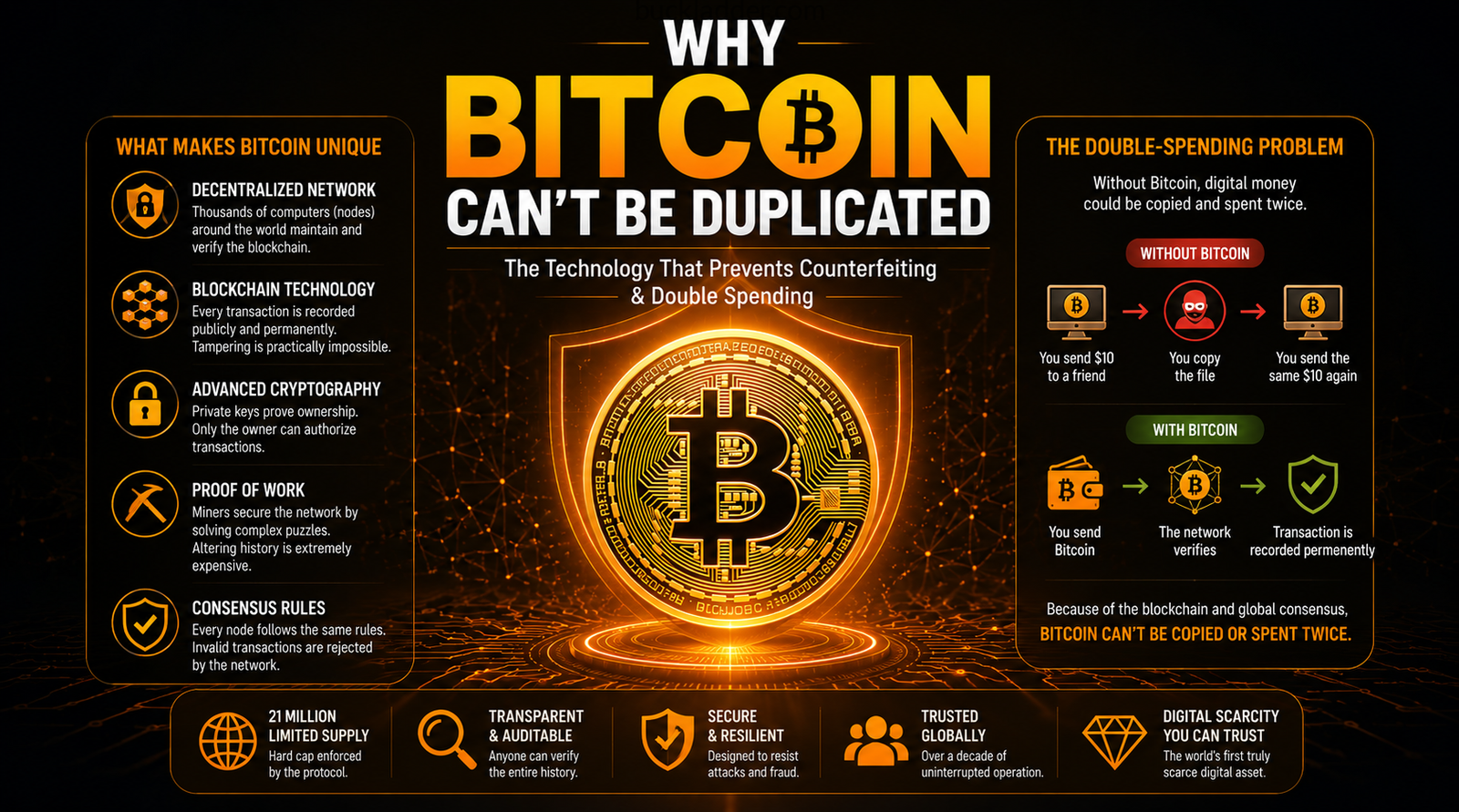
The Double-Spending Problem
Before Bitcoin, digital money faced a fundamental challenge known as the double-spending problem.
Imagine you have a digital dollar.
What’s stopping you from:
- Sending it to one person
- Copying it
- Sending the same dollar to another person
In the digital world, information can be duplicated effortlessly.
Without a way to verify ownership and spending history, digital money would be worthless because anyone could create copies.
This problem prevented true decentralized digital money from existing for decades.
How Traditional Banking Solves the Problem
Banks solve double spending through centralized record keeping.
When you spend money:
- The bank updates its database.
- Your balance decreases.
- The recipient’s balance increases.
The bank acts as a trusted authority that prevents the same money from being spent twice.
The downside is that everyone must trust the bank.
Bitcoin introduced a different solution.
Bitcoin’s Revolutionary Idea
Instead of trusting a bank, Bitcoin relies on a decentralized network.
Thousands of computers around the world maintain identical copies of Bitcoin’s transaction history.
This shared ledger is called the blockchain.
Every Bitcoin transaction is recorded publicly and permanently.
When someone attempts to spend Bitcoin, the network verifies:
- The Bitcoin exists.
- The sender owns it.
- It has not already been spent.
If the transaction is valid, it becomes part of Bitcoin’s permanent record.
What Actually Happens When You Own Bitcoin?
Many people imagine Bitcoin as a digital coin sitting inside a wallet.
That’s not quite accurate.
Bitcoin ownership is really an entry on the blockchain.
Your wallet doesn’t hold Bitcoin itself.
Instead, it holds cryptographic keys that prove your right to control specific Bitcoin on the network.
Ownership is verified through mathematics rather than physical possession.
Why Copying Bitcoin Doesn’t Work
Suppose someone copies every file associated with their Bitcoin wallet.
Have they created more Bitcoin?
No.
They have only copied information.
The blockchain still shows who owns the Bitcoin.
The copied files do not create new coins.
The network only recognizes transactions that are properly signed by the owner’s private key and verified by consensus.
This means that copying wallet data does not create additional Bitcoin.
The Blockchain: Bitcoin’s Master Record
Think of the blockchain as the world’s largest accounting ledger.
Every Bitcoin transaction since January 2009 is recorded within it.
Whenever ownership changes:
- The transaction is verified.
- The ledger updates.
- Every node on the network receives the update.
Because thousands of computers maintain identical records, altering ownership becomes extraordinarily difficult.
To create fake Bitcoin, an attacker would need to rewrite the blockchain itself.
Why Counterfeiting Bitcoin Is Nearly Impossible
Counterfeiting a dollar bill requires creating a convincing replica.
Counterfeiting Bitcoin would require altering the entire network’s transaction history.
Several security mechanisms prevent this.
Cryptography
Bitcoin uses advanced cryptographic algorithms.
These mathematical functions secure ownership and transactions.
Without the correct private key, spending someone else’s Bitcoin is effectively impossible.
Consensus Rules
Every node on the network follows the same rules.
Invalid transactions are automatically rejected.
Decentralization
Thousands of independent computers verify transactions.
No single entity controls the network.
Proof of Work
Bitcoin miners expend computational resources to secure the blockchain.
This makes altering historical records extremely expensive.
What About Creating Another Bitcoin?
A common misconception is:
“If Bitcoin’s software is open source, why can’t someone simply copy it?”
In reality, many people have.
Thousands of cryptocurrencies have been created using Bitcoin’s code.
Examples include:
- Litecoin
- Bitcoin Cash
- Dogecoin
- Numerous other forks
However, copying the code is not the same as copying Bitcoin.
The Difference Between Copying Code and Copying a Network
Imagine someone builds a social media platform identical to Facebook.
They can copy the software.
But can they instantly copy billions of users?
No.
The network itself has value.
Bitcoin works similarly.
Its value comes from:
- Millions of users
- Global recognition
- Infrastructure
- Security
- Mining network
- Institutional adoption
- Liquidity
Anyone can copy Bitcoin’s software.
No one can duplicate the network effects built over more than fifteen years.
The 21 Million Coin Supply Limit
Another reason Bitcoin cannot be duplicated is its fixed supply.
Bitcoin’s protocol specifies that only 21 million coins can ever exist.
This limit is enforced by every node on the network.
If someone attempted to create extra Bitcoin beyond this limit:
- Their version of the blockchain would violate network rules.
- Other nodes would reject it.
- The fake coins would have no legitimacy.
The entire network collectively enforces scarcity.
Could Quantum Computers Break Bitcoin?
One concern frequently discussed involves quantum computing.
Future quantum computers could potentially challenge certain cryptographic systems.
However:
- Current quantum computers are nowhere near this capability.
- Bitcoin developers actively research quantum-resistant solutions.
- Any credible threat would likely be addressed through network upgrades long before it becomes practical.
While worth monitoring, quantum computing does not currently threaten Bitcoin’s integrity.
Why Bitcoin’s Scarcity Matters
Because Bitcoin cannot be duplicated, many investors view it as digitally scarce.
This scarcity is one reason Bitcoin is often compared to gold.
Both assets possess characteristics such as:
- Limited supply
- Difficulty of creation
- Resistance to counterfeiting
- Global recognition
The key difference is that Bitcoin’s scarcity can be mathematically verified.
Anyone can independently verify the total supply at any time.
Is Bitcoin the First Truly Scarce Digital Asset?
Many experts believe so.
Before Bitcoin:
- Digital files could be copied infinitely.
- Digital ownership was difficult to prove.
- Digital scarcity did not truly exist.
Bitcoin introduced a way to create and verify scarcity in the digital world.
This breakthrough paved the way for:
- Cryptocurrencies
- NFTs
- Tokenized assets
- Blockchain-based ownership systems
Why This Innovation Is So Important
Bitcoin’s greatest achievement may not be its price appreciation.
It may be solving a computer science problem that had existed for decades.
For the first time in history, people could transfer value online without needing a central authority to prevent duplication and fraud.
That innovation created an entirely new asset class and launched a global industry.
Final Thoughts
Bitcoin cannot be duplicated because ownership is verified through cryptography, consensus, decentralization, and a publicly auditable blockchain.
While anyone can copy Bitcoin’s software, no one can copy its transaction history, security, network effects, or established trust.
Every Bitcoin on the network can be traced through a transparent ledger maintained by thousands of independent computers around the world.
That is why Bitcoin remains unique.
Its true innovation isn’t merely digital money.
It’s the creation of a digital asset that can be scarce, verifiable, and resistant to duplication without relying on a central authority.
In many ways, Bitcoin solved a problem that many computer scientists once believed was impossible to solve.