Crypto Exchanges Explained: How Cryptocurrency Exchanges Work, Why They Matter, and How to Choose the Right One
If Bitcoin is the world’s largest cryptocurrency and blockchain is the technology powering crypto, then cryptocurrency exchanges are the marketplaces that make the entire ecosystem accessible.
Without exchanges, most people would have no practical way to buy, sell, trade, or store digital assets.
Today, cryptocurrency exchanges process billions of dollars in transactions daily and serve hundreds of millions of users worldwide. They have become the bridges connecting traditional finance with the rapidly growing digital asset economy.
But what exactly is a crypto exchange, how does it work, what are the risks, and how do you choose the right one?
This guide covers everything you need to know.
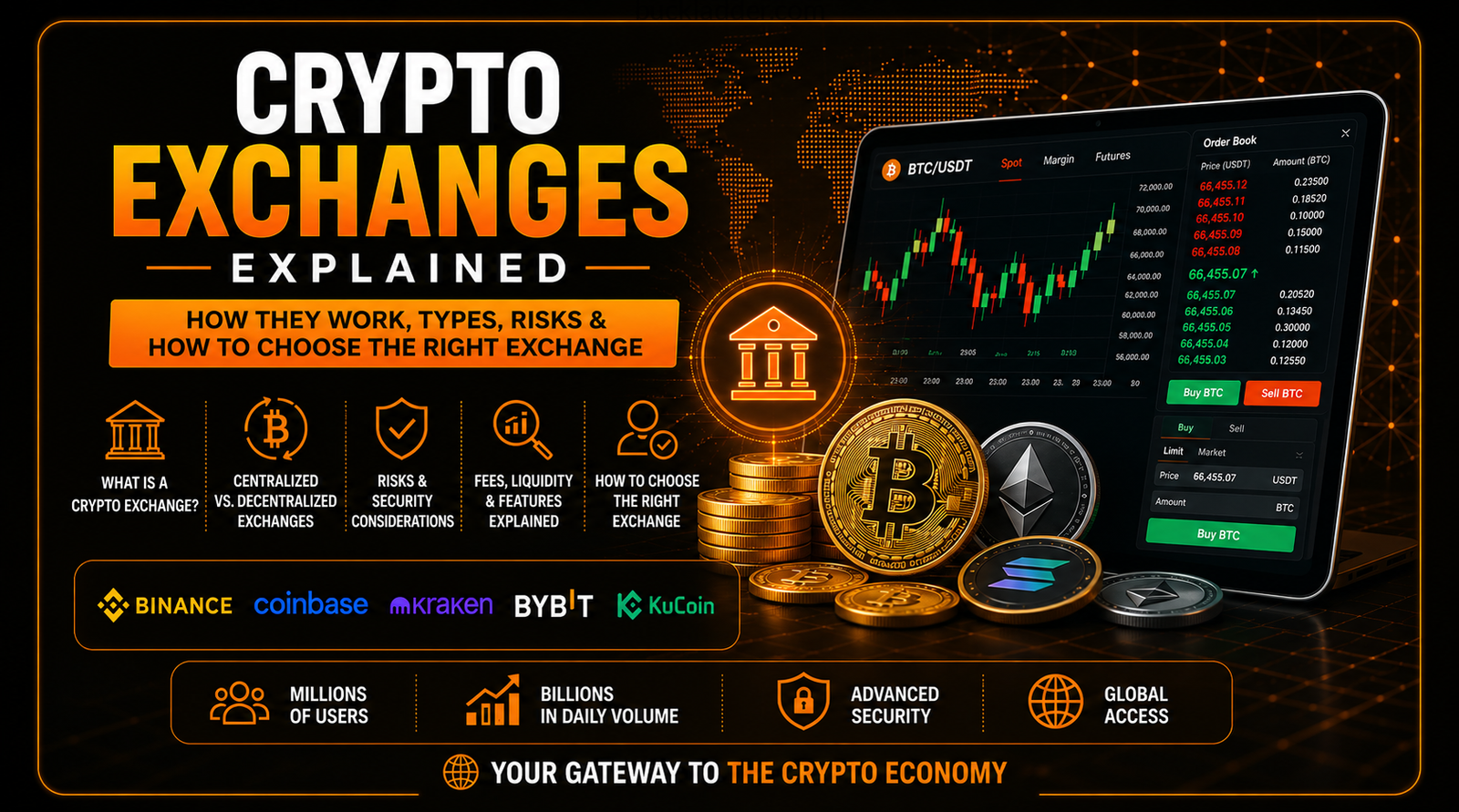
What Is a Crypto Exchange?
A cryptocurrency exchange is a platform where users can buy, sell, trade, and sometimes store cryptocurrencies.
Think of a crypto exchange as the cryptocurrency equivalent of a stock brokerage.
Just as investors use brokerage firms to purchase stocks, crypto investors use exchanges to purchase digital assets such as:
- Bitcoin
- Ethereum
- Solana
- XRP
- Stablecoins
- Thousands of other cryptocurrencies
Crypto exchanges act as marketplaces that connect buyers and sellers.
Why Crypto Exchanges Exist
In Bitcoin’s early years, purchasing cryptocurrency was extremely difficult.
People often bought Bitcoin directly from other individuals through forums and online communities.
This process was:
- Slow
- Complicated
- Risky
- Inefficient
Crypto exchanges emerged to solve these problems by creating organized marketplaces where transactions could occur quickly and securely.
Today, exchanges have become one of the most important components of the cryptocurrency ecosystem.
How Crypto Exchanges Work
At a basic level, exchanges match buyers with sellers.
Imagine:
- Alice wants to buy Bitcoin.
- Bob wants to sell Bitcoin.
The exchange matches their orders and facilitates the transaction.
Modern exchanges also provide:
- Price charts
- Market data
- Wallet services
- Trading tools
- Security features
- Educational resources
Most transactions occur within seconds.
The Two Main Types of Crypto Exchanges
Centralized Exchanges (CEXs)
Centralized exchanges are operated by companies that manage the platform.
Examples include:
- Coinbase
- Kraken
- Binance
- Crypto.com
- Gemini
These exchanges function similarly to traditional financial institutions.
Users create accounts, complete identity verification, and deposit funds.
Advantages
- Beginner-friendly
- High liquidity
- Customer support
- Faster transactions
- Easier fiat currency deposits
Disadvantages
- Users do not directly control assets while funds remain on the exchange
- Potential hacking targets
- Regulatory risks
- Counterparty risk
Decentralized Exchanges (DEXs)
Decentralized exchanges allow users to trade directly from their wallets without relying on a central company.
Popular DEXs include:
- Uniswap
- PancakeSwap
- Jupiter
- Curve Finance
Instead of companies managing trades, smart contracts automate transactions.
Advantages
- Self-custody
- Greater privacy
- Reduced counterparty risk
- Permissionless access
Disadvantages
- Steeper learning curve
- No customer support
- Smart contract risks
- Potential liquidity limitations
[Smart contracts are pieces of code that automatically execute transactions when certain conditions are met. While they eliminate the need for intermediaries, they are only as secure as the code written by developers. If a bug, vulnerability, or design flaw exists, attackers may exploit it to steal funds or manipulate transactions. Unlike traditional financial institutions, there is often no customer support department or insurance fund capable of reversing losses after an exploit occurs. For this reason, users should research protocols carefully and understand that smart contract risk is one of the primary risks associated with decentralized exchanges.]
The History of Crypto Exchanges
The Mt. Gox Era
One of the earliest and most famous exchanges was Mt. Gox.
At one point, Mt. Gox handled the majority of Bitcoin trading volume worldwide.
In 2014, the exchange collapsed after losing hundreds of thousands of Bitcoin, highlighting the importance of security and risk management.
The collapse became one of the defining moments in crypto history.
Investigations later revealed that Mt. Gox had suffered from years of security weaknesses, poor internal controls, and repeated thefts. Hackers were believed to have gradually drained Bitcoin from the exchange’s wallets over an extended period without management fully understanding the scale of the losses. By the time the problem became public, approximately 850,000 Bitcoin had gone missing, making it one of the largest losses in cryptocurrency history.
The Mt. Gox collapse demonstrated several important lessons:
- Exchanges can fail.
- Poor security practices can have catastrophic consequences.
- Users who leave large amounts of crypto on exchanges face counterparty risk.
- Transparency and proper auditing are essential.
The event remains one of the most important cautionary tales in the cryptocurrency industry.
The Rise of Professional Exchanges
Following Mt. Gox, more sophisticated exchanges emerged with stronger security, compliance programs, and infrastructure.
Companies such as Coinbase, Kraken, and Binance helped bring cryptocurrency to mainstream audiences.
How Exchanges Make Money
Crypto exchanges generate revenue through several methods.
Trading Fees
The most common source of income.
Every trade typically generates a small fee.
Withdrawal Fees
Some exchanges charge fees when users transfer assets off-platform.
Listing Fees
Certain exchanges charge projects to list new cryptocurrencies.
Staking Services
Many exchanges allow customers to earn staking rewards while sharing revenue with the platform.
Staking is a process used by many proof-of-stake blockchains, including Ethereum, Solana, Cardano, and Avalanche. Instead of using energy-intensive mining, these networks rely on validators who lock up cryptocurrency as collateral to help secure the network and verify transactions.
In return for participating, validators earn rewards. Exchanges simplify this process by allowing customers to stake their assets directly through the platform. The exchange pools customer funds, operates validators, and distributes rewards while typically keeping a percentage as a service fee.
For investors, staking can provide passive income on idle crypto holdings. However, staking also carries risks, including:
- Lock-up periods that restrict withdrawals
- Validator penalties, known as slashing
- Smart contract risks in certain staking protocols
- Exchange custody risks if staking through a centralized platform
Understanding these risks is important before committing assets to staking programs.
Interest and Lending Programs
Some exchanges generate income through lending services.
What Can You Buy on a Crypto Exchange?
Modern exchanges offer far more than Bitcoin.
Common assets include:
Bitcoin
The largest cryptocurrency.
Ethereum
The leading smart contract platform.
Stablecoins
Digital assets pegged to traditional currencies.
Examples:
- USDT
- USDC
- DAI
Altcoins
Alternative cryptocurrencies such as:
- Solana
- Avalanche
- Cardano
- XRP
- Chainlink
Meme Coins
Highly speculative assets such as:
- Dogecoin
- Shiba Inu
- Pepe
Understanding Exchange Wallets
When you buy crypto on an exchange, the exchange often holds your assets on your behalf.
This is known as custodial storage.
Many investors eventually move assets to personal wallets for greater control.
The crypto community often repeats a popular phrase:
“Not your keys, not your coins.”
This reflects the idea that true ownership comes from controlling your private keys.
A private key is a secret cryptographic code that proves ownership of cryptocurrency. Whoever controls the private key controls the assets associated with that wallet. If someone gains access to your private key, they can transfer your funds. If you lose your private key and do not have a backup, your cryptocurrency may be permanently inaccessible.
When assets are stored on a centralized exchange, the exchange controls the private keys on your behalf. This makes the platform convenient to use, but it also means users are trusting the exchange to remain solvent, secure, and operational.
When investors move assets to a self-custody wallet, they gain direct control over their private keys and therefore direct ownership of their cryptocurrency. This eliminates much of the counterparty risk associated with centralized exchanges but also places full responsibility for security on the user.
Self-custody is one of the most powerful features of cryptocurrency because it allows individuals to own and control assets without relying on banks, brokers, or other intermediaries.
The Importance of Liquidity
Liquidity refers to how easily an asset can be bought or sold.
High-liquidity exchanges generally offer:
- Better pricing
- Faster execution
- Lower spreads
- Reduced slippage
Liquidity is one reason larger exchanges often attract more users.
To understand why liquidity matters, imagine two different exchanges.
On Exchange A, Bitcoin has millions of dollars in buy and sell orders available at any given moment. If you want to buy $10,000 worth of Bitcoin, your order will likely execute instantly at a price very close to the current market rate.
On Exchange B, there are very few active traders and limited buy and sell orders. If you attempt to purchase the same amount of Bitcoin, your order may push the price higher because there are not enough sellers available at the current price level.
This difference is known as slippage.
Liquidity becomes even more important for larger investors. For example, a hedge fund attempting to buy $10 million worth of Bitcoin would prefer a highly liquid exchange because it can execute large trades without significantly affecting market prices.
Low liquidity can also create problems during periods of market volatility. When prices move rapidly, traders on illiquid exchanges may struggle to enter or exit positions efficiently, potentially resulting in worse prices and larger losses.
For most investors, choosing an exchange with strong liquidity can improve trading efficiency and reduce hidden costs.
Risks of Using Crypto Exchanges
While exchanges provide convenience, they also introduce risks.
Exchange Hacks
Hackers have stolen billions of dollars from exchanges over the years.
Regulatory Risk
Governments may impose restrictions on exchange operations.
Insolvency Risk
Some exchanges have collapsed due to poor management or fraud.
Custody Risk
Users relying on exchanges must trust the platform to safeguard assets.
The FTX Collapse: A Lesson in Risk
The collapse of FTX in 2022 became one of the largest failures in cryptocurrency history.
Millions of customers were affected.
The event reinforced several important lessons:
- Transparency matters.
- Self-custody has value.
- Diversification reduces risk.
- Trust should never replace verification.
The fallout reshaped how many investors think about exchange risk.
How to Choose a Crypto Exchange
Before selecting an exchange, consider:
Security
Does the platform have a strong security track record?
Regulatory Compliance
Does the exchange operate legally within your jurisdiction?
Fees
How much does trading cost?
Asset Selection
Does the platform offer the cryptocurrencies you want?
Liquidity
Can trades be executed efficiently?
User Experience
Is the platform beginner-friendly?
Customer Support
Can assistance be reached when needed?
The Future of Crypto Exchanges
Crypto exchanges continue evolving rapidly.
Several trends are shaping the future.
Institutional Services
Exchanges increasingly serve hedge funds, banks, and corporations.
Tokenized Assets
Stocks, bonds, and real estate may eventually trade alongside cryptocurrencies.
Decentralized Trading Growth
DEXs continue gaining market share.
Enhanced Security
Proof-of-reserves, improved custody solutions, and stronger compliance standards are becoming more common.
Global Adoption
As cryptocurrency adoption grows, exchanges are likely to become increasingly integrated into the global financial system.
Final Thoughts
Crypto exchanges are the gateways into the digital asset economy.
They allow millions of people to access Bitcoin, Ethereum, stablecoins, and thousands of other cryptocurrencies.
Whether you’re a beginner making your first Bitcoin purchase or an experienced trader managing a diversified portfolio, understanding how exchanges operate is essential.
The best exchange is not necessarily the one with the most cryptocurrencies or the lowest fees.
It’s the one that balances security, reliability, liquidity, compliance, and usability in a way that aligns with your goals.
As cryptocurrency continues maturing, exchanges will remain among the most important institutions connecting traditional finance and the blockchain economy.