
How the Real Estate Market Really Works: Why Home Prices Go Up, Down, and Sometimes Make No Sense
Imagine This…
Two nearly identical houses sit on the same street.
Same size. Same number of bedrooms. Same tired-looking mailbox.
One sells for $350,000.
Three months later, the house next door sells for $415,000.
Nothing major changed.
No pool.
No remodel.
No secret underground wine cellar.
So what happened?
That’s the real estate market in action.
It can feel mysterious from the outside, but once you understand the moving parts, the whole thing starts to make sense. Prices rise, fall, and sometimes seem completely random because real estate is shaped by a mix of math, emotion, timing, and local demand.
And yes, sometimes a house is worth more simply because the buyer showed up on the right day.
Think of the Real Estate Market Like an Auction
Picture a small town with only 10 homes for sale.
Now imagine 100 families all trying to buy one.
What happens?
People compete.
Offers get stronger.
Buyers start stretching their budgets.
Sellers get confident.
Prices climb.
Now flip it.
Imagine 100 homes for sale and only 10 buyers.
Suddenly, sellers are the ones competing.
They lower prices.
They offer incentives.
They hope someone bites.
That’s the heart of the housing market.
Supply and Demand
When demand is greater than supply…
📈 Prices usually rise.
When supply is greater than demand…
📉 Prices usually fall.
That’s the basic rule.
But real estate doesn’t stop there. A lot more is happening behind the scenes.
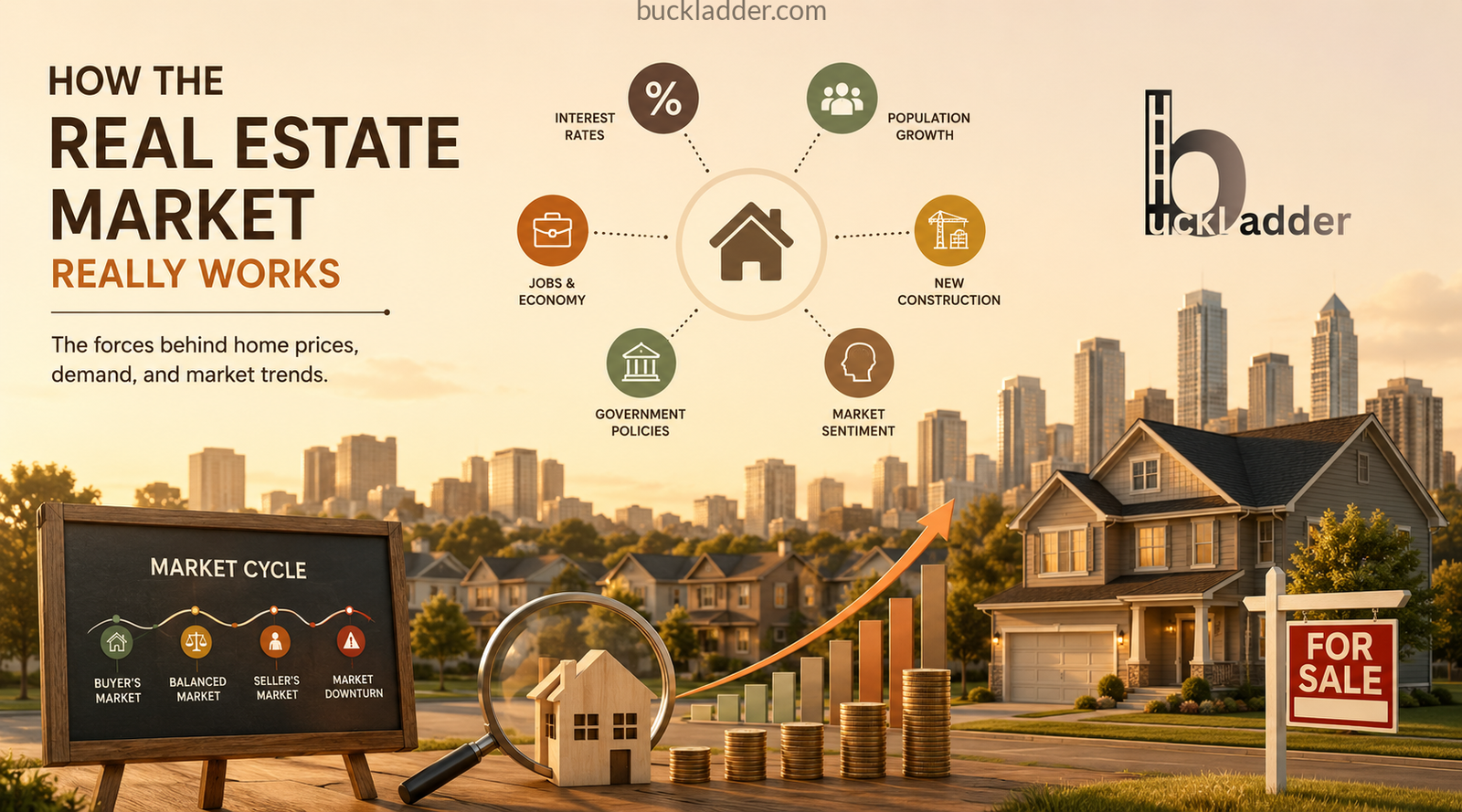
Meet the Six Forces That Control the Housing Market
Think of these as the invisible hands moving prices every day.
1. Interest Rates: The Silent Price Controller
Interest rates may not sound exciting, but they can change everything.
Here’s a simple example.
You can afford a monthly mortgage payment of $2,000.
If mortgage rates are 3%, that payment might let you buy a $450,000 home.
If rates rise to 7%, the same payment might only buy a $300,000 home.
Your paycheck didn’t change.
The house didn’t change.
Only the cost of borrowing changed.
That’s why rising interest rates often cool the market. Buyers suddenly can’t afford as much, so demand slows down.
A tiny percentage change can have a huge effect on home prices.
2. Jobs Create Housing Demand
People move where the jobs are.
That’s why a city with a booming tech industry, new hospitals, or expanding factories often sees more people arriving.
More jobs usually mean:
- More buyers
- More renters
- More competition for homes
- Higher property values
Here’s the practical version:
If a company opens a major office and hires 5,000 workers, those workers need somewhere to live.
Some buy homes.
Some rent apartments.
Some do both over time.
Either way, housing demand goes up.
That’s why strong job growth often leads to a stronger housing market.
3. Population Growth
More people means more roofs needed.
It sounds obvious, but it matters a lot.
If a city adds 50,000 residents a year, that city needs:
- Houses
- Apartments
- Condos
- Rental homes
- New neighborhoods
When population grows faster than housing supply, prices usually rise.
A surprising fact: some of the fastest-growing housing markets aren’t the biggest cities. They’re the places people are quietly moving to for affordability, weather, or lifestyle.
Real estate follows people.
Always has.
4. New Construction
Builders play a huge role in keeping the market balanced.
If enough homes are built, buyers have more choices and prices tend to stabilize.
If construction slows down while demand stays strong, inventory shrinks.
And when inventory shrinks, buyers start competing harder.
That’s when bidding wars happen.
A practical example:
- A neighborhood has 20 homes for sale.
- Builders stop adding new homes.
- Ten more families move into the area.
Now there are fewer homes available for more buyers.
Prices usually move up.
Construction doesn’t just add houses. It helps decide whether the market feels calm or chaotic.
5. Government Policies
Government decisions can change the housing market faster than people realize.
Examples include:
- Tax incentives
- Zoning laws
- Building regulations
- Infrastructure projects
- Interest-rate policies
Here’s a real-world style example:
A city announces a new highway exit, train station, or business district.
Suddenly, that area becomes easier to reach.
More people want to live there.
Businesses move in.
Developers pay attention.
Home values often rise.
Sometimes a neighborhood changes not because the houses got better, but because the city around them did.
That’s a big reason location matters so much.
6. Human Emotion
This is the part people forget.
Real estate is not just numbers. It’s people.
And people get emotional.
When buyers hear that prices are rising fast, they panic and rush to buy before they’re “priced out.”
That extra demand pushes prices even higher.
When headlines scream about a crash, buyers freeze.
They wait.
They hesitate.
They hope for a better deal.
That slowdown can soften prices.
So yes, fear and excitement can move the market almost as much as interest rates and supply.
That’s why real estate can feel irrational.
Because humans are involved.
The Four Types of Real Estate Markets
Knowing what kind of market you’re in helps explain why homes sell the way they do.
Seller’s Market
There are more buyers than homes.
That usually means:
- Multiple offers
- Fast sales
- Rising prices
- Buyers waiving contingencies just to compete
This is great for sellers.
Not so great for buyers who want time to think.
In a seller’s market, a house can sell before the open house even ends.
Buyer’s Market
There are more homes than buyers.
That usually means:
- Longer time on market
- Price cuts
- More negotiation power
- Better deals for buyers
This is the market where buyers can breathe a little.
They may ask for repairs.
They may negotiate closing costs.
They may even get the seller to lower the price.
Balanced Market
Supply and demand are fairly even.
That usually means:
- Steady price growth
- Less frantic bidding
- More normal negotiations
This is the closest thing real estate has to “calm.”
Neither side has a huge advantage.
Bubble Market
Sometimes prices rise much faster than incomes or rents.
People buy because they think prices will keep climbing forever.
That can create a bubble.
When confidence breaks, prices can fall quickly.
A bubble market often feels exciting right before it feels dangerous.
That’s why people who study real estate closely watch for signs that prices are rising too fast, too soon.
Why Two Similar Homes Can Sell for Different Prices
This is where real estate gets interesting.
Two houses can look almost identical and still sell for very different amounts.
Why?
Because buyers are not just buying walls and windows.
They’re buying the neighborhood, the commute, the school district, the street, and the feeling they get when they pull into the driveway.
Factors that matter include:
- School quality
- Crime rates
- Nearby parks
- Shopping and restaurants
- Public transportation
- Future developments
- Neighborhood reputation
A house on one block might sell for far more than a nearly identical house three streets over.
That’s not a mistake.
That’s location.
A surprising fact: sometimes a small improvement nearby, like a new coffee shop or train stop, can raise interest in an entire area.
Real estate is local in a way most people don’t expect.
The Hidden Cost of Waiting
A lot of people wait to buy because they hope prices will drop.
Sometimes they do.
Sometimes they don’t.
Here’s a simple example.
A home costs $300,000 today.
If it rises by 5% a year:
- After 1 year, it’s about $315,000
- After 5 years, it’s about $383,000
That’s a big difference.
Waiting can help if prices fall.
But waiting can also make the same house much more expensive.
That’s why timing the market is so hard.
Most people think they can wait for the “perfect moment.”
The problem is, the perfect moment usually only becomes obvious after it’s gone.
Real Estate Is Local
You’ve probably heard someone say:
“The housing market is booming!”
That might be true.
But maybe only in one city.
Or one neighborhood.
Or one zip code.
Meanwhile, another area could be slowing down at the exact same time.
That’s why smart buyers don’t just watch national headlines.
They study local data.
They ask questions like:
- Are homes selling quickly?
- Are prices rising or flattening?
- Are new jobs coming into the area?
- Is inventory tight?
- Are builders active?
Real estate is not one giant market.
It’s thousands of small markets happening at once.
Fun Facts That Surprise Most People
Here are a few things that catch people off guard:
- A freshly painted front door can make a home feel more valuable.
- Trees and landscaping can increase perceived property value.
- Homes near strong schools often sell for more, even to buyers without kids.
- Walkable neighborhoods are becoming more desirable and can boost demand.
- A house doesn’t need to be the biggest on the block to be the most valuable.
And one of the biggest truths in real estate still holds up:
Location, location, location.
People say it so often because it keeps proving true.
Common Mistakes People Make
A lot of buyers and sellers make the same mistakes.
❌ Thinking prices only go up
❌ Buying more than they can comfortably afford
❌ Forgetting about taxes, insurance, repairs, and maintenance
❌ Focusing only on the house and ignoring the neighborhood
❌ Letting emotions make the decision instead of the numbers
A house can look perfect and still be a bad financial move.
That’s why smart buyers slow down long enough to look at the full picture.
What Smart Buyers Watch
Experienced buyers don’t just look at the listing price.
They watch the signals behind the price.
Things like:
- Mortgage interest rates
- Local job growth
- Population trends
- New construction
- Inventory levels
- Days on market
- Comparable recent sales
These clues help them understand whether the market is heating up, cooling down, or staying steady.
Think of it like weather forecasting.
You may not know exactly when it will rain, but you can still tell whether the sky is getting darker.
Real-World Example
Imagine a city announces a new technology campus that will create 8,000 jobs.
At first, nothing looks different.
The land is still empty.
The buildings aren’t finished.
But the market starts reacting immediately.
Investors buy nearby properties.
Renters move in early.
Restaurants and stores open nearby.
Builders start planning new projects.
By the time the campus opens, home prices may already be much higher.
The buildings didn’t change overnight.
The expectations did.
That’s how real estate often works.
People buy based on what they think will happen next.
Is the Real Estate Market Predictable?
Not perfectly.
That’s the honest answer.
Experts study data every day.
They track rates, inventory, jobs, and sales.
But no one can predict the future with complete accuracy.
That’s why the smartest homeowners and investors focus on long-term fundamentals instead of short-term noise.
They don’t try to guess every twist.
They try to understand the bigger story.
And in real estate, the bigger story usually comes down to one thing:
Who needs housing, how much housing is available, and what it costs to borrow money.
Key Takeaways
The real estate market is not random.
It’s shaped by supply and demand, interest rates, jobs, population growth, construction, government policies, and human emotion.
That’s why home prices can rise quickly, fall suddenly, or seem to make no sense at all.
Once you understand the forces behind the market, you can make smarter decisions, whether you’re:
- Buying your first home
- Selling a property
- Investing in rentals
- Or just trying to understand why your neighbor’s house sold for more than yours
The next time someone asks, “Why are house prices so high?” you’ll know the answer is usually not just one thing.
It’s a whole chain of events working together behind the scenes.