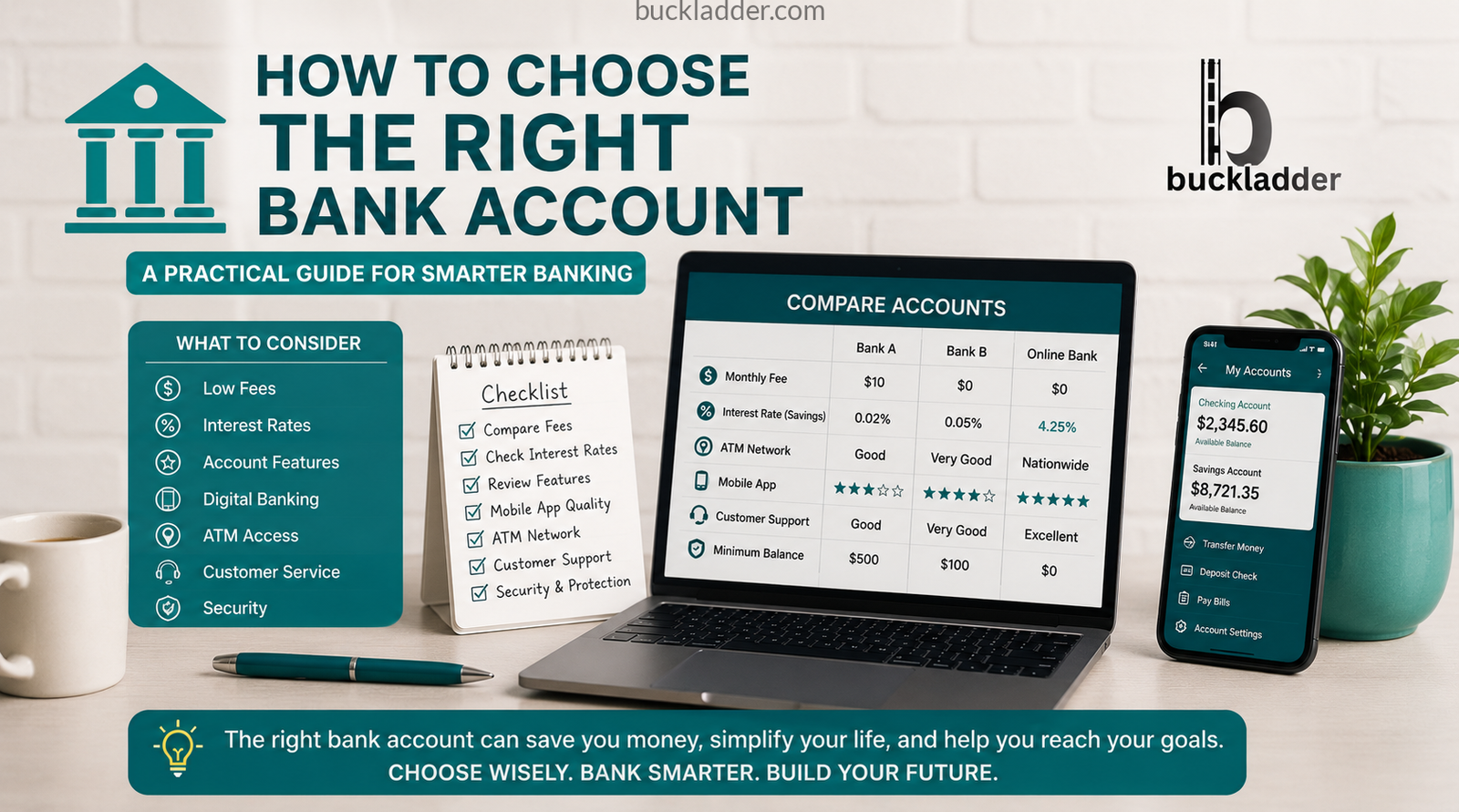
How to Choose the Right Bank Account: A Complete Practical Guide
Opening a bank account seems simple until you’re faced with dozens of options. Every bank claims to offer the “best” account, but the right choice depends on how you manage your money.
A poor choice can cost you hundreds of dollars each year through maintenance fees, ATM charges, overdraft fees, and low interest rates. The right account, however, can help you save money, simplify your finances, and support your long-term financial goals.
A practical case is a no-fee checking account like Capital One 360 Checking, Discover Cashback Debit, or SoFi Checking and Savings, which may be a strong fit for everyday spending. On the savings side, a high-yield account such as Ally Bank Online Savings, Marcus by Goldman Sachs High-Yield Savings, or American Express High Yield Savings can help your emergency fund grow.
This guide will walk you through everything you need to know before opening a bank account.
Why Choosing the Right Bank Account Matters
A bank account is more than just a place to keep your money.
It’s where you:
- Receive your salary
- Pay bills
- Save for emergencies
- Transfer money
- Build healthy financial habits
The wrong account can make everyday banking frustrating and expensive.
The right account works quietly in the background, making money management easier.
Take a bank that charges a monthly fee and out-of-network ATM fees. You may lose money every month without realizing it. A fee-friendly option such as Capital One 360 Checking, Discover Cashback Debit, or Charles Schwab Bank High Yield Investor Checking can help reduce those costs.
Step 1: Understand Your Financial Needs
Before comparing banks, ask yourself a few simple questions.
- Will this be your main account?
- Do you receive regular paychecks?
- Do you use cash often?
- Do you travel frequently?
- Do you want to earn interest?
- Will you mainly bank online?
- How often do you withdraw cash?
Your answers determine which features matter most.
If you get paid by direct deposit, pay bills online, and rarely visit a branch, a digital-first option like SoFi Checking and Savings, Capital One 360 Checking, or Discover Cashback Debit may fit your lifestyle better than a traditional branch-heavy bank.
Step 2: Know the Different Types of Bank Accounts
Checking Accounts
Checking accounts are designed for everyday spending.
Typical features include:
- Debit card
- Direct deposit
- Bill payments
- ATM access
- Mobile banking
- Online banking
Best for:
- Paying monthly bills
- Salary deposits
- Daily purchases
- Managing household expenses
Strong options include Capital One 360 Checking, Discover Cashback Debit, and SoFi Checking and Savings, which are popular no-fee checking choices for people who want simple everyday banking.
Savings Accounts
Savings accounts help you separate money you don’t plan to spend immediately.
Benefits include:
- Interest earnings
- Emergency savings
- Financial discipline
- Easy transfers
Best for:
- Emergency funds
- Vacation savings
- Home down payments
- Future purchases
Popular choices include Ally Bank Online Savings, Marcus by Goldman Sachs High-Yield Savings, and American Express High Yield Savings, all of which are strong fits for people who want a high-yield savings account with easy online access.
Money Market Accounts
Money market accounts combine features of checking and savings accounts.
Advantages:
- Higher interest rates
- Limited check-writing
- Debit card access (at many banks)
Ideal for larger balances that still need occasional access.
Worth considering are CIT Bank Platinum Savings, UFB Direct Premier Savings, and Vio Bank Cornerstone Money Market Savings, which can be practical options for savers who want competitive rates on larger balances.
Certificates of Deposit (CDs)
CDs require locking your money away for a fixed period.
In exchange, banks usually offer higher interest rates.
Best suited for money you won’t need immediately.
A few solid picks are Marcus by Goldman Sachs CDs, Synchrony Bank CDs, and Discover Bank CDs, especially if you want to lock in a fixed rate for money you do not plan to use soon.
Step 3: Compare Banking Fees
Many people overlook fees until they’re charged.
Look for:
Monthly Maintenance Fees
Some banks charge simply for having an account.
Choose accounts with:
- No monthly fees
- Easy fee waivers
- Free checking options
A few strong no-monthly-fee options are Capital One 360 Checking, Discover Cashback Debit, and SoFi Checking and Savings, which work well for many everyday users.
ATM Fees
Ask:
- Are ATMs widely available?
- Does the bank reimburse out-of-network ATM fees?
Frequent ATM users should pay close attention.
A useful comparison includes Charles Schwab Bank High Yield Investor Checking, Fidelity Cash Management Account, and Alliant Credit Union High-Rate Checking, all of which are known for ATM-friendly features that can help travelers and frequent cash users.
Overdraft Fees
One accidental overdraft can cost $30–$40 or more.
Look for banks that offer:
- Overdraft protection
- Low overdraft fees
- No overdraft fees
A smart set of options here includes Discover Cashback Debit, Capital One 360 Checking, and Ally Bank Spending Account, which are useful for people who want to avoid overdraft fees altogether.
Foreign Transaction Fees
If you travel internationally, these fees can quickly add up.
Travel-friendly choices include Charles Schwab Bank High Yield Investor Checking, HSBC Premier Checking, and Fidelity Cash Management Account, all of which can offer more flexibility abroad.
Step 4: Consider Interest Rates
Not all bank accounts earn the same amount.
Traditional savings accounts often pay relatively low interest.
High-yield savings accounts may offer significantly better returns.
Although interest rates change over time, even small differences become meaningful as your savings grow.
A high-yield account such as Marcus by Goldman Sachs High-Yield Savings, American Express High Yield Savings, or Ally Bank Online Savings may help your savings grow faster than a basic savings account at a traditional bank.
Step 5: Evaluate Digital Banking Features
Modern banking should be convenient.
Look for:
- Mobile deposits
- Instant transfers
- Bill pay
- Spending alerts
- Budgeting tools
- Digital wallets
- Card locking
- Biometric login
A well-designed mobile app can save hours every year.
Digital-first options such as SoFi Checking and Savings, Capital One 360 Checking, and Discover Cashback Debit are strong choices for people who want modern app features and easy online money management.
Step 6: Check Customer Service
Problems happen.
Choose a bank that offers:
- 24/7 support
- Live chat
- Telephone assistance
- Local branches (if important)
- Fast issue resolution
Good customer service becomes invaluable when something goes wrong.
Worth comparing are Charles Schwab Bank, Chase, and Bank of America, especially if customer support matters to you.
Step 7: Think About Security
Your bank should prioritize protecting your money.
Look for:
- Multi-factor authentication
- Fraud monitoring
- Account alerts
- Encryption
- Debit card controls
- Deposit insurance where applicable
Security should never be an afterthought.
Security-focused options include Capital One, Chase, and Discover, all of which offer tools and protections that can help customers monitor and protect their money.
Online Banks vs. Traditional Banks
Online Banks
Advantages
- Higher savings rates
- Lower fees
- Excellent mobile apps
- Convenient digital services
Disadvantages
- No physical branches
- Cash deposits may be less convenient
Digital-first banks such as Ally Bank, Discover Bank, and SoFi are strong options for people who prefer online banking.
Traditional Banks
Advantages
- Face-to-face service
- Branch access
- Cash deposits
- Personalized assistance
Disadvantages
- Lower interest rates
- More fees
- Older technology at some institutions
Branch-based institutions like Chase, Bank of America, and Wells Fargo are common choices for people who want in-person support.
Practical Example
Meet David.
He receives his salary electronically, pays bills online, rarely visits a branch, and wants to grow his emergency fund.
For David:
- A no-fee checking account like Capital One 360 Checking, Discover Cashback Debit, or SoFi Checking and Savings is ideal.
- A separate high-yield savings account like Ally Bank Online Savings, Marcus by Goldman Sachs High-Yield Savings, or American Express High Yield Savings helps his emergency fund earn more interest.
- If he travels often, a fee-friendly account like Charles Schwab Bank High Yield Investor Checking, Fidelity Cash Management Account, or HSBC Premier Checking could also be a smart choice.
He avoids unnecessary fees while keeping his finances organized.
The best account isn’t the one with the most features—it’s the one that fits your lifestyle.
Common Mistakes to Avoid
Choosing the Closest Bank
Convenience matters, but fees and features matter more.
A nearby branch may be less useful than a better-value account like Capital One 360 Checking, Discover Cashback Debit, or SoFi Checking and Savings.
Ignoring Fees
Many people unknowingly lose hundreds of dollars every year to avoidable banking fees.
A bank with no monthly fee and no overdraft fee, such as Discover Cashback Debit, Ally Bank Spending Account, or Capital One 360 Checking, may save you more money than a bank with a flashy sign-up bonus.
Keeping Everything in One Account
Mixing spending money with savings often leads to overspending.
Separate accounts encourage better financial habits.
You might use Capital One 360 Checking, Discover Cashback Debit, or SoFi Checking and Savings for spending and Ally Bank Online Savings, Marcus by Goldman Sachs High-Yield Savings, or American Express High Yield Savings for savings.
Ignoring Mobile Banking Quality
A poor banking app can make routine tasks frustrating.
Read reviews before opening an account.
Digital-first banks like SoFi, Capital One, and Discover are often worth comparing if app quality matters to you.
Step-by-Step Timeline
Day 1
List your banking needs.
Think about whether you need:
- A checking account
- A savings account
- A high-yield option
- Branch access
- Strong mobile banking
Day 2
Compare several banks.
Review:
- Fees
- Interest
- Features
- ATM network
- Mobile app ratings
A useful comparison is Capital One, Ally Bank, and Discover Bank, which can help you see which one fits your needs best.
Day 3
Select the best account.
Gather:
- Identification
- Proof of address (if required)
- Initial deposit
If you want a simple online checking account, Capital One 360 Checking, Discover Cashback Debit, or SoFi Checking and Savings may be practical choices.
Week 1
Open the account.
Set up:
- Direct deposit
- Mobile banking
- Account alerts
- Bill payments
If you choose SoFi Checking and Savings, Capital One 360 Checking, or Ally Bank Online Savings, you can set up many of these features directly in the app.
Month 1
Track your experience.
Evaluate:
- Customer service
- App usability
- Hidden fees
- Ease of transfers
If the account doesn’t meet your needs, switch early.
Should branch access matter more than expected, you may want to compare your current account with a traditional bank like Chase, Bank of America, or Wells Fargo.
Comparing Popular Account Types
| Feature | Checking | Savings | Money Market | Certificate of Deposit | Example Banks (3 Options) |
|---|---|---|---|---|---|
| Daily Spending | ⭐⭐⭐⭐⭐ | ⭐ | ⭐⭐ | ❌ | Capital One 360 Checking, Discover Cashback Debit, SoFi Checking and Savings |
| Earn Interest | Low | Moderate | Higher | Often Highest | Ally Bank Online Savings, Marcus by Goldman Sachs High-Yield Savings, American Express High Yield Savings |
| Debit Card | Yes | Sometimes | Often | No | Discover Cashback Debit, Capital One 360 Checking, Charles Schwab Bank High Yield Investor Checking |
| Emergency Fund | Good | Excellent | Excellent | Poor | CIT Bank Platinum Savings, UFB Direct Premier Savings, Vio Bank Cornerstone Money Market Savings |
| Long-Term Savings | Fair | Good | Very Good | Excellent | Marcus by Goldman Sachs CDs, Synchrony Bank CDs, Discover Bank CDs |
Is Choosing the Right Bank Account Worth It?
Buck Ladder Score: 10/10 ⭐⭐⭐⭐⭐
Choosing the right bank account can help you:
- Avoid unnecessary fees
- Earn more interest
- Stay organized
- Improve cash flow
- Simplify everyday banking
- Build stronger financial habits
A simple setup such as Capital One 360 Checking paired with Ally Bank Online Savings or Discover Cashback Debit paired with Marcus by Goldman Sachs High-Yield Savings can create a low-cost structure for many people.
A few hours of research today can save you hundreds—or even thousands—of dollars over the years.
Career Insight: Why This Knowledge Matters
You don’t need to work in finance to benefit from understanding bank accounts.
Whether you’re a student, employee, entrepreneur, freelancer, or retiree, choosing the right account affects your daily financial life. It’s one of the first and most important financial decisions you’ll make.
A freelancer may prefer a digital-first bank like SoFi, Capital One, or Discover, while someone who handles cash often may prefer a traditional bank like Chase, Bank of America, or Wells Fargo.
Future Outlook
Banking is becoming increasingly digital.
Expect continued growth in:
- AI-powered financial assistants
- Instant payments
- Personalized budgeting tools
- Enhanced fraud detection
- Digital identity verification
- Integrated investment and savings features
Consumers who understand banking fundamentals will be better equipped to take advantage of these innovations.
Banks like Capital One, SoFi, and Discover are already investing heavily in digital tools and app-based banking experiences.
Key Takeaways
- Choose a bank account based on your financial habits—not advertising.
- Compare fees before opening an account.
- Look for strong mobile banking features if you bank digitally.
- Separate your spending and savings into different accounts.
- Consider both online and traditional banks based on your needs.
- Review your bank account annually to ensure it still fits your financial goals.
A practical starter setup might be Capital One 360 Checking for spending and Ally Bank Online Savings or Discover Cashback Debit for savings and everyday flexibility.
Final Thoughts
The best bank account isn’t necessarily the one with the biggest sign on the street or the most television commercials. It’s the one that supports your financial goals, minimizes costs, and makes managing your money simple.
Take your time, compare your options carefully, and remember that switching banks is always possible if your needs change. Choosing wisely today lays the foundation for better financial decisions tomorrow.
For many people, a combination like Capital One 360 Checking and Ally Bank Online Savings or Discover Cashback Debit and Marcus by Goldman Sachs High-Yield Savings offers a practical, low-fee starting point.